Enveyo Stage

Blog

  • Multi-Carrier Parcel Shipping Software: 5 Automation Tools for Overcoming Supply Chain Challenges

    Multi-Carrier Parcel Shipping Software: 5 Automation Tools for Overcoming Supply Chain Challenges

    The e-commerce shipping industry is facing various supply chain challenges, and solving them is becoming more complex by the day. So how can shippers overcome these obstacles now and in the future? The answer is multi-carrier parcel shipping software. In this blog, we look at five automation tools for conquering supply chain challenges.

    E-commerce shipping is all about getting parcels delivered to customers on time and within budget. When customers place an online order, they expect their package to arrive by the delivery date. If that doesn’t happen, the customer loses trust in the shipper and rethinks their next purchase. Therefore, e-commerce shippers need to provide a superior delivery experience every single time.

    But the pandemic disrupted the entire supply chain. Many packages are taking longer to deliver and cost more to ship. There are many reasons for these problems, and they’re complicated:

    • Carrier capacity limitations
    • Supply chain labor shortages
    • Delivery experience expectations from consumers

    Because these problems are complex, they aren’t going away anytime soon. In order to compete in the short-term, many shippers are considering or shifting to omnichannel fulfillment as well as same-day and last-mile shipping.

    However, shippers need to find a long-term solution for overcoming today’s challenges and preventing them in the future. The answer is multi-carrier parcel shipping software. But how do you know if you need it?

    3 Signs You Need Multi-Carrier Parcel Shipping Software


    1. Reliance on Manual Processes

    Since e-commerce shipping includes many moving parts, it’s hard to keep up when completing tasks by hand.

    If you’re relying on a carrier’s website to create shipping labels, the time it takes to manually type in your shipping data can be time-consuming. First, you need to go to a carrier’s website and manually type in the data for each carrier’s shipping labels. Then, you need to figure out how to efficiently pack your items to ensure you’re accurately accounting for dimensional pricing.

    Package prices vary based on how much space and weight a package will take up on the carrier’s vehicle. If you don’t get the price correct on the label, the carrier will add surcharges, leading to you spending more money than you need to on shipping.

    2. Single Carrier Shipping

    Another sign you need parcel shipping software is if you rely on a single carrier to ship all of your packages. With today’s supply chain obstacles, you need to expand your operations to include multiple national, regional, and final mile carriers so that you can pivot your shipping needs when necessary. That way, you can get your parcels delivered on time and within budget.

    3. High Shipping Volume

    When your shipping volume grows to the point where manual processes are more cumbersome than useful, and your single carrier shipping strategy is causing delays, it’s a clear sign that you need parcel shipping software.

    You don’t want to lose business because your carrier can’t handle the volume. Instead, it’s time to upgrade your shipping platform with software that includes practical automation tools that selects the best carrier, service, and rate for every package.

    What Multi-Carrier Parcel Shipping Software Do You Need?


    Multi-carrier parcel shipping software empowers you to make the best shipping decisions, which saves time and money while improving your customer satisfaction and building customer loyalty.

    But you can’t just buy parcel shipping software and call it a day. You need to ensure you get the right automation tools to take your operations to the next level.

    Here are five automation tools that you should look for in multi-carrier parcel shipping software:

    1. Cloud transportation management system (TMS)
    2. Delivery experience management
    3. Parcel auditing
    4. Parcel spend management
    5. Logistics optimization

    1. Cloud Transportation Management System (TMS)

    One automation tool you need is a cloud transport management system (TMS). This advanced decisioning engine will help you:

    • Choose the right sized package for each shipment
    • Select the carrier with the best rate
    • Pick the service with the fastest route

    Choose the Right Sized Package for Each Shipment

    Before you get your package on a carrier’s vehicle, the first thing you need to do is pack your shipment. A major benefit of a cloud TMS is cartonization. Cartonization is an automated function that selects the right sized box or packaging for each shipment. The system takes in the size, shape, and weight of each item from your OMS/WMS to automate the decision of which size box to use.

    Bigger and heavier packages will cost more because carrier fees rely on how much space a package takes up in a vehicle, so finding the optimal package size is crucial. And suppose you’re shipping multiple packages to a single customer. In that case, you can set up an algorithm for the smartest shipping method and pricing so your manifesting system can tell you if using one or multiple boxes gets the best rate. This will also help you avoid additional dimensional weight (DIM) charges.

    Select the Carrier With the Best Rate

    Before the supply chain disruption, shippers could get away with only having one carrier. But times have changed, and many shippers are worried about capacity issues, especially during their peak shipping season(s). Therefore, a multi-carrier strategy is vital to making sure you can get your parcels to customers in the timeframe you promised them.

    But choosing the best carriers for rates and other surcharges can be time-consuming if you do it manually. With a cloud TMS, you’re able to smart shop and find the perfect carriers for your parcels at every mile of its journey.

    Another benefit is that a cloud TMS considers carrier accessorial charges when suggesting which carrier is right for your needs. Accessorial charges can include:

    • Residential surcharges
    • Indoor and white-glove deliveries
    • Fuel surcharges
    • Oversized and overlength packages
    • Hazardous materials

    As you can imagine, trying to consider all these accessorial charges manually is a laborious process. However, you can cut through the noise with a cloud TMS to determine the carriers that make sense for your shipping requirements.

    Select the Service With the Fastest Route

    Since speed plays a crucial role in the success of your shipping operations, it’s important to know the fastest route for each shipment based on the delivery option your customers select at checkout. With a cloud TMS, you can create an automated ruleset that combines the rate and route to choose the optimal option for every package.

    This tool makes it easy to change and combine rulesets to find the fastest route and cheapest rate, which puts you in a better position to satisfy your customers and control your shipping costs.

    2. Delivery Experience Management

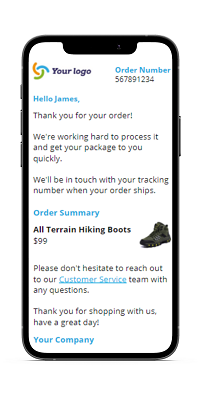
    When a customer makes an online purchase, they want to follow each step of the delivery process, from the time the package ships to the moment it ends up at their door. In the e-commerce space, this is often called shipment visibility, delivery experience, or real-time order communication.Alerting Order Confirmation Email
    To provide these package shipment insights, you need a delivery experience management tool that gives real-time shipping alerts to your customer regarding the status of their package throughout its lifecycle, including:

    • Order creation
    • Order shipped
    • Package out for delivery
    • Delivery delay or exception
    • Package delivered

    These real-time notifications are often sent by email or SMS, and they create a positive post-purchase experience that helps to build brand loyalty and increase returning customers.

    The tool can also offer valuable shipment lifecycle reporting that allows you to increase efficiency and save money.

    3. Parcel Auditing

    When a carrier doesn’t meet a contractual agreement, you may be eligible for a refund. But if you don’t have an automated parcel auditing tool to review carrier performance and automate refunds, you could be missing out on recovering revenue.

    Parcel auditing software monitors individual shipments and determines if they are delivered according to your carrier agreements, the rate charged, and any surcharges incurred. Not only does this kind of tool save you the time and effort of manual audits, but it can review all of the relevant variables on every shipment to capture eligible refunds.

    4. Parcel Shipping Analytics

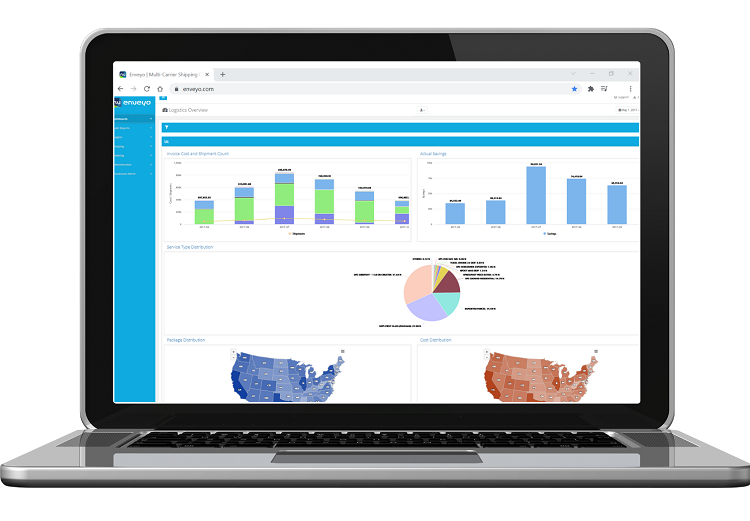
    Determining parcel spend by manually combining data from many sources is time-consuming and error-prone. A parcel shipping analytics tool alleviates these concerns by integrating with multiple systems to cleanse and normalize the data, providing you with deeper insights into your shipping program. And if the tool has reporting built-in, you can utilize the reports for making smarter decisions faster.

    For example, these reports can give you a deeper look into:

    • Parcel time in transit, including how long carriers are in transit for each shipment
    • Variable costs, such as costs for each carrier’s services and all accessorial charges
    • Geographical buying trends so you can make smarter shipping decisions based on where the largest subset of your customers are

    With these insights, you can compare carrier performance and benchmark against accessible, real-world data. You will also be able to negotiate terms based on specific shipping patterns, weights and service types.

    Data visibility is an ongoing challenge for third-party logistics providers (3PLs) and their customers. Customers want to see their data for how the 3PL provider is performing for them, and the 3PL needs to enable that visibility. Parcel shipping analytics software enables this level of visibility because it includes the metrics that both the shipper and the customer want to see. The 3PL can see their shipping operations and performance holistically while also providing white-labeled reporting for their customers.

    The tool also serves as billing management software for 3PL providers to distribute accurate bills to their customers. It accounts for what each customer owes you based on the rates and discounts you’ve contracted with the carriers without exposing your native rates to clients. This saves you money, time, and the hassle of trying to figure it all out manually, which makes an even bigger difference when you work with multiple brands nationwide.
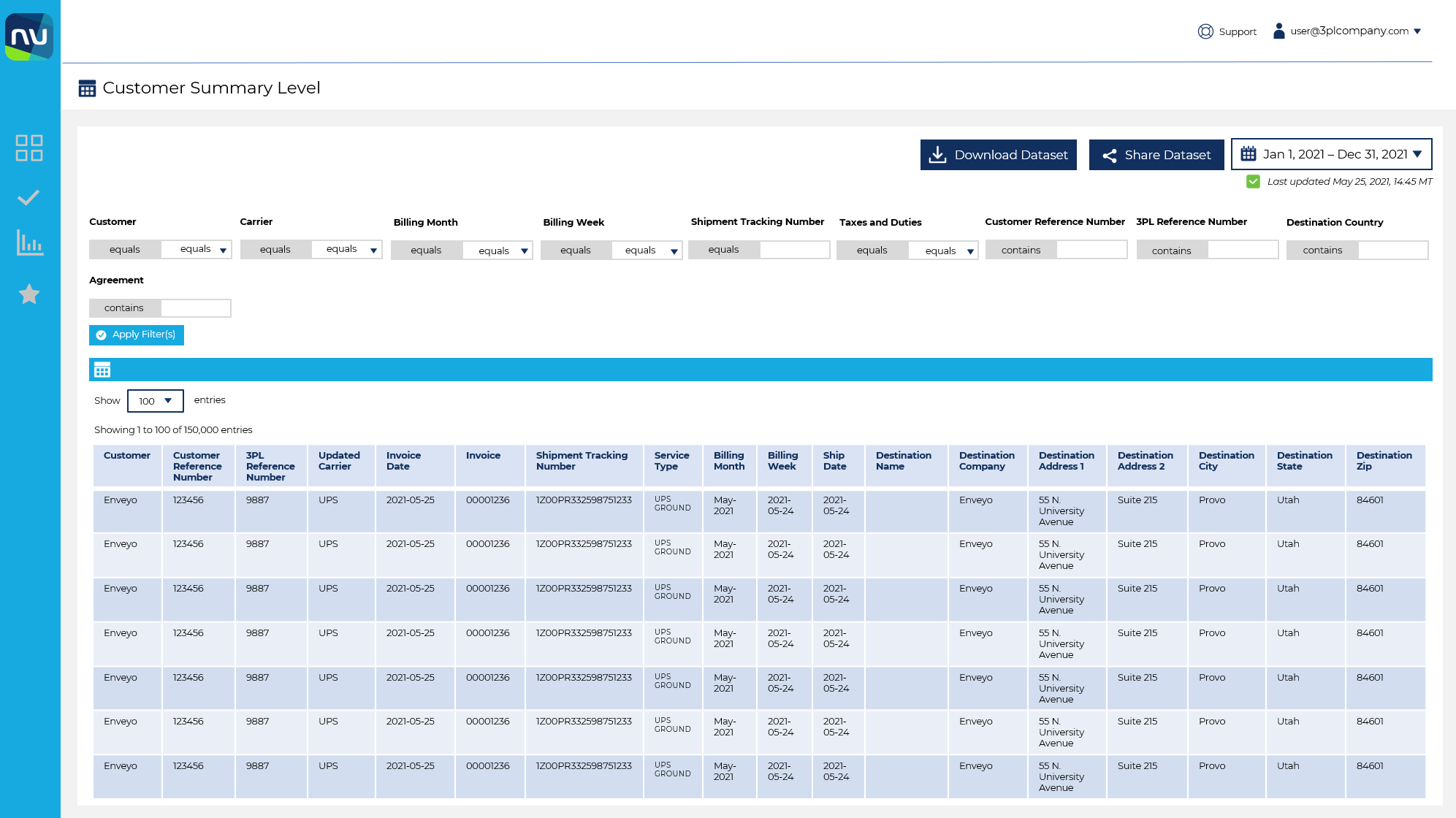
    Enveyo Insights Platform

    5. Logistics Optimization

    Optimizing your shipping operations is challenging, especially if you’re a 3PL provider. When onboarding a new customer, you may be considering if you should use your established carrier rates or the rates your customer negotiated. It’s important you make the best business decision for both the 3PL and the customer.

    To help with this, get a logistics optimization tool for modeling 3PL customer decision-making. This tool can predict business outcomes to future scenarios to help determine whether the relationship between you and the 3PL makes sense for both parties before you make the shift. It uses data from multiple systems to answer unknown questions and model real-life scenarios.

    For example, if you lack warehouse space, it may be enticing to work with a 3PL to optimize package fulfillment. But how do you know if that’s a good business decision? Use the logistics optimization tool to analyze and model shipping data and create possible outcomes so you can determine if the partnership shows promise.

    Similarly, shippers can use logistics optimization software to gain a more accurate view of potential long-term impacts before teaming up with a carrier. Logistics optimization finds the story in the shipping data and brings it to life through modeling. As a result, shippers gain a deeper understanding of how the business relationship would work and they can make a data-driven decision.

    Multi-Carrier Parcel Shipping Software Platform Benefits


    Now that you know what multi-carrier parcel shipping software tools to consider, it’s time to think about whether you should get individual solutions or an all-in-one platform.

    While it may be tempting to get only the tools you think you need now, it can be more expensive to implement tools that don’t natively communicate with each other. Plus, you may find that you need more functionality down the line to solve new challenges, which only leads to higher costs and more headaches.

    Shippers will benefit from a SaaS software suite with all tools interconnected under one data management platform because centralizing & standardizing your data in one system helps you avoid systems communication & upgrade issues downstream. You’ll also save money and internal resources by implementing one software license for the suite of tools instead of individual licenses from various software providers. This way, you won’t have to worry about needing to purchase a different tool later on. Instead, you’ll be able to pivot right away, avoiding downtime in both implementation and training your team.

    A multi-carrier parcel shipping software platform can even help to:

    • Reduce human touchpoints
    • Solve the challenge of workforce issues
    • Make smarter decisions
    • Increase efficiency

    Conclusion


    Many e-commerce shippers are worried about today’s supply chain challenges. Shippers can’t claim surprise with respect to pandemic-related disruptions this year. If they’re unprepared, it’s because they didn’t evolve. To set themselves up for success, shippers need multi-carrier parcel shipping software to automate processes and make smart decisions.

    Enveyo’s shipping and logistics management software delivers data-driven results that drive your business forward. Schedule a demo to see how your shipping program can benefit from our all-in-one software solution.

  • What is Predictive Logistics Modeling? 5 Core Basics

    What is Predictive Logistics Modeling? 5 Core Basics

    Predictive logistics modeling is analysis of “what if” scenarios to help your organization avoid costly decisions and plan for the future. Let’s dive into 5 core basics of predictive logistics modeling.

    As a kid in the 80’s, we had it pretty good – great music, questionable hair and clothing styles, and on top of that we had Marty McFly. Marty had the sweetest ride, crazy kicks that laced themselves up, and except for the occasional water hazard, his skateboard floated. All that was great, but my full appreciation for the genius of the man came when he had the foresight to attempt to bring back Grays Sports Almanac from the future. Clearly, he had a plan and was smarter than the rest of us. If not for Doc’s concern about the tremendous risk of catastrophic disruptions to the “space-time continuum,” he could have been set for life leveraging his newly acquired knowledge to accurately “predict” the outcome of every sporting event.

    Well, here we are more than 6 years past that imaginary future (Oct 21st, 2015) and we still don’t have time travel, flying cars, or hoverboards – and there are less than 7,000 DeLoreans still on the road. That said, technology has advanced tremendously to support the ongoing need to anticipate or predict the future and make better business decisions in an accelerated timeframe. With predictive logistics modeling technology that can consume, process, and analyze enormous amounts of data in short order, business leaders can make critical decisions with a very high degree of confidence in the outcome.


    What is Predictive Logistics Modeling?


    While we don’t have the ability to travel into the future and retrieve an Almanac or other literature containing events that will occur, technology innovations provide us with the ability to get pretty close. Predictive logistics modeling provides the ability to leverage available data to answer business-impacting questions with a very high probability of predicting the future outcome. So, while it may not make us clairvoyant or provide us with a perfect lens into what will actually occur in the future, from a business standpoint, it’s an extremely powerful tool that allows organizations to understand the downstream impact of their choices before making shifts.

    In this blog, we’ll cover 5 core basics of predictive logistics modeling, and how leveraging this strategic, big-data technology can help prevent you from making a costly mistake.

    1. Analyze Potential Outcomes Against Future Scenarios

    Parcel shipping volume has grown at an exponential rate and is showing no signs of slowing down. In the last 18 months, most shippers had to modify their distribution processes to respond to the rapid surge in direct-to-consumer shipments. Consumer behavior has been trending away from physical in-store purchasing for years – the pandemic just dramatically accelerated that transition. I think we’re all sick of the phrase “new normal,” but that’s what this is. Online purchasing and e-commerce aren’t slowing down and certainly aren’t going away, which means the demand for a fast and accurate delivery experience will continue to increase.

    Shippers are quickly learning that they’re competing more on delivery experience and speed of service than brand loyalty. So how do you respond?

    Do you:

    1. Add distribution center(s) closer to your customers to get products to them faster?
    2. Diversify your carrier strategy and partner with multiple national and regional carriers to get the best possible rates for each package?
    3. Implement a “Prime-like” subscription program so those customers who opt-in always receive fast and reliable shipping?

    Each shipper will make the decision that is best for the health of their business, but how can you be sure it’s a “healthy” decision? Even small, seemingly insignificant changes to your logistics program can have considerable implications down the road. These implications are difficult, if not impossible to predict using traditional reporting tools.

    Predictive logistics modeling software accurately shows the short-term and long-term impacts to each scenario your business is considering. By using your data and analyzing relevant shipping program variables against carrier data and market actuals, predictive logistics modeling provides the meaningful data that enables your organization to confidently make the “healthy” choice.

    2. Consider All the Variables

    Today’s shipping landscape is complex with many variables to consider. Variables that traditional analytics software may not see. In gathering data and analyzing all the relevant variables, predictive logistics modeling can tell you where your business is struggling and where the opportunities lie. Then naturally, a strategic plan is put into action to capitalize on those opportunities. But more importantly, a plan where the decisions are driven by data.

    Some of the vital metrics predictive logistics modeling considers in the shipping context include:

    • Your company’s actual shipping patterns
    • Service charges & fees
    • Alternative carrier options with national, regional, and final mile carriers
    • Package characteristics like dimensions & weights
    • Accessorial and peak-season surcharges
    • Market averages & trends
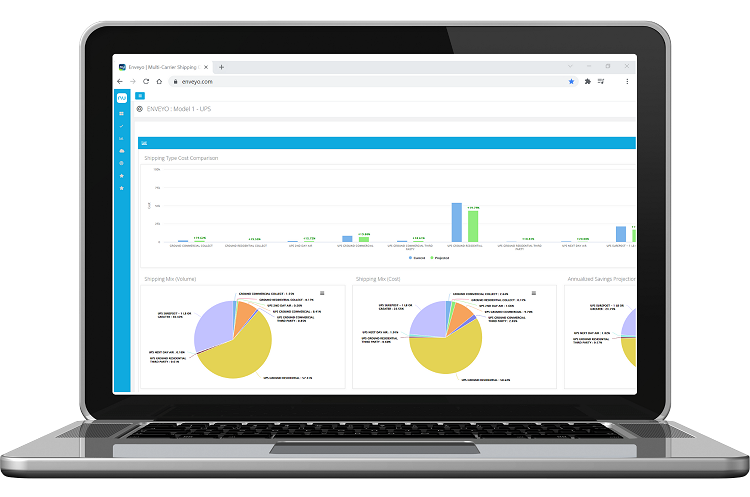
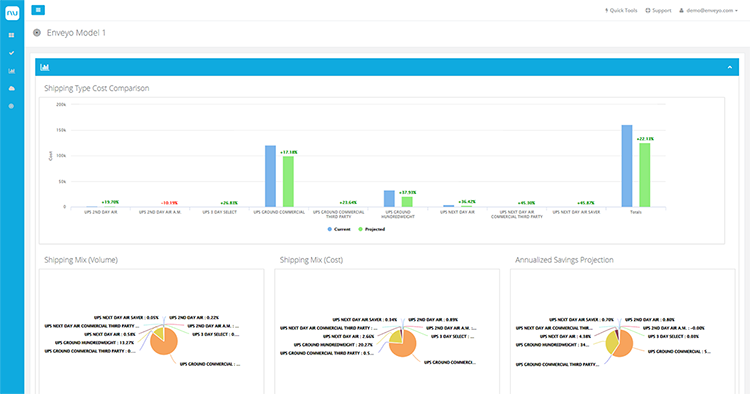
    • Carrier performance & other qualitative metrics like time in transit & on-time performanceEnveyo Modeling Dashboard

    The market volatility that shippers currently face is leaving them with more questions than answers. Questions that could make or break their business, and unfortunately, put job security at risk if the correct decision isn’t made.

    Since we’re on the topic of job security risk, let’s explore other risks that predictive logistics modeling software can reduce.

    3. Shipping Program Risk Management

    We hear it often, “it’s not broken, so we don’t need to fix it.” While that may be true, fixing it is reactive. A proactive shift in shipping strategy could propel your business into new markets, add thousands (or millions) back to your bottom line, and enable crucial gains in competitive advantage. And quite frankly, you don’t know what you don’t know. It might be broken.

    The good news is that predictive logistics modeling can tell you what you don’t know. By analyzing every relevant variable, logistics modeling software easily incorporates your actual shipping data into modeling scenarios that lets you measure downstream impact prior to execution, showing you both the risks and opportunities that lay ahead.

    Let the data tell the story, and more importantly, determine the appropriate course of action for shipping optimization and risk mitigation. With predictive logistics modeling, you reduce the risk out of making blind adjustments (aka guessing) to your shipping program.

    4. Moving Beyond Traditional Software (And Third-Party Consultants)

    The statement, “we’ve always done it that way,” doesn’t cut it anymore. The e-commerce landscape is shifting too fast to stay competitive by maintaining the status quo.

    That’s why when we hear things like,

    “We don’t have a consolidated system for managing, manifesting, and reporting on all of our shipments”

    or,

    “We work with a third-party partner who finds & negotiates the best carrier rates for us,”

    we ask questions that challenge those “we’ve always done it that way” answers.

    These approaches to shipping strategy may work, but they are costing you more in up-front & overhead expenses, and limit the desired output, for example:

    • Third-party negotiators will take a cut of their identified savings. Leveraging a SaaS predictive logistics modeling application ensures that the savings identified will add money back to your bottom line, not someone else’s.
    • To effectively model outcomes against potential future scenarios, data silos and disparate systems will be a continued burden. Collecting, cleansing, and normalizing data when there are thousands or millions of line-items from multiple internal and external systems isn’t a job for legacy tools.

    It often takes the threat of competitive takeover, risk of job replacement or new leadership to trigger the evaluation of alternate logistics software platforms & processes. Proactively modeling market risks & opportunities can move your organization forward before threats arise.

    5. 3PL Sales Modeling for Client Onboarding

    More companies are turning to Third Party Logistics (3PL) providers to optimize order fulfillment and improve the customer delivery experience. 3PLs however, can’t onboard every customer that wants them to handle product fulfillment. So how do 3PLs know which companies to partner with?

    To be certain of a good fit, 3PLs should leverage predictive logistics modeling to model customer data and quickly determine if there is a mutual fit.

    With predictive logistics modeling, 3PLs can:

    • Review the prospect’s secured carrier rates versus their own rates for various carriers, modes, and service types to determine how much money they can save the client
    • Quickly prove their value to prospective clients with actionable data, which could secure their business over a competing 3PL provider
    • Make data-driven decisions that enable faster & more efficient product fulfillment, making their clients more profitable and increasing brand loyalty for both the client and the 3PL

    Based on real data, 3PLs can confidently predict what their return on investment (ROI) will be should they decide to partner with this client for product fulfillment. Because of the quick & accurate predictive logistics modeling results, 3PLs can also speed up their deal closure, creating a quicker path to profit.

    Enveyo Modeling Software

    Conclusion

    Developing a shipping strategy is a complex process that is too often based on guesswork. Predictive logistics modeling helps you make sound, future-proof decisions to decrease costs, increase efficiency, and gain competitive advantage.

    Tired of shipping strategy guesswork? We can help. Schedule a demo of Enveyo Modeling to see the future potential of your shipping program.

  • Enveyo Launches Customer Delivery Experience Management Solution, Alerting

    Enveyo Launches Customer Delivery Experience Management Solution, Alerting

    Enveyo Expands Its Suite of Logistics Optimization Software Products. Real-Time Shipment Alerting Solution Enables Greater Visibility for E-Commerce Shippers & Their Customers.

    Provo, UT (October 19th, 2021) – Enveyo, a leading Transportation Management System (TMS) and logistics optimization software provider, today announced the launch of its customer delivery experience management solution, Alerting. Enabling real-time visibility across the lifecycle of parcel shipments, Alerting gives e-commerce shippers the ability to increase revenue & customer satisfaction, while driving brand loyalty.  

    Alerting is the latest addition to the Enveyo suite of logistics optimization software products, including predictive analytics application, Modeling, comprehensive business intelligence reporting tool, Insights, intuitive TMS, Cloudroute, and carrier performance auditing solution, Audit. This comprehensive set of solutions makes Enveyo the only logistics software platform enabling end-to-end supply chain visibility in a single SaaS platform.  

    Customer delivery experience management has become an essential piece of the e-commerce landscape, as shoppers demand more visibility and consistent communication across the journey of their packages. Alerting solves this challenge for shippers by enabling real-time shipment notifications across key milestones of the package’s journey from creation to delivery, as well as delivery exceptions.  

    E-Commerce Shipping Benefits with Enveyo Alerting Delivery Experience Software: 

    • Increase customer communication, build trust & brand loyalty through real-time shipment notifications. From order creation to package delivery, and unexpected delivery exceptions, customers continue to interact with your brand through multiple key milestones along the package’s journey.  
    • Create a seamless customer delivery experience through email or SMS notifications configurable to customize the shipper’s unique messaging & brand styling.  
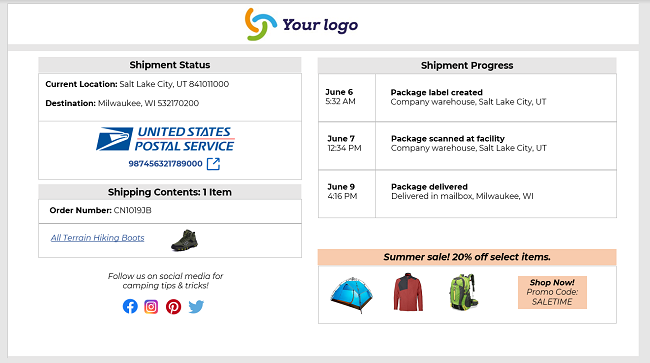
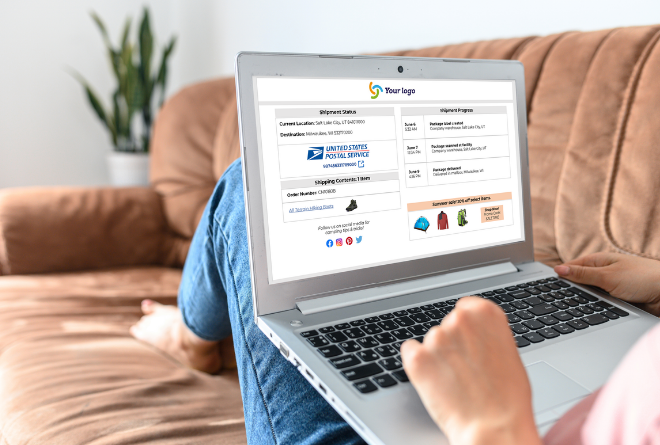
    • Extend your brand experience with a white-labeled landing page detailing the package’s full status & progress history with the ability to add dynamic product placements and announcements. 

    To support e-commerce shippers in making intelligent, data-driven decisions, shipment lifecycle reporting delivers insights across all organizational shipping data in both out-of-the-box and customizable dashboards, so shippers spend less time cleansing & analyzing data, and more time building brand loyalty. 

    “Data collection & management is an ongoing challenge for shippers,” says John Errebo, Enveyo’s co-founder & CTO. “We’re on a mission to help organizations leverage that data & technology to drive business-transforming shipping decisions, and the introduction of Alerting is another exciting step forward for that mission.” 

    Coby Nilsson, Enveyo’s co-founder & CEO says, “We consistently see that consumers demand visibility. From the moment the purchase is made to the moment the doorbell rings, consumers want transparency. We’re excited that Alerting enables that level of transparency and interaction between companies and end consumers to further establish trust & brand loyalty.” 

    To learn more about Alerting and the Enveyo suite of logistics optimization software solutions, visit enveyo.com

  • Delivery Experience Management: 4 Ways to Build Customer Loyalty with Automated Software

    Delivery Experience Management: 4 Ways to Build Customer Loyalty with Automated Software

    Delivery experience management is an increasingly critical piece of the e-commerce puzzle. Today’s shoppers demand better insight, communication and delivery times. Here are 4 ways e-commerce shippers can use automated software to step up to the plate.

    US retail e-commerce sales for the second quarter of 2021 was $211.7 billion, a 7.6% jump from the first quarter, and a 9% jump from the second quarter of 2020. And it’s not slowing down.

    E-Commerce brands pour millions into marketing & advertising to get buyers to their online stores and create personalized shopping experiences to increase the likelihood of a sale.

    But what happens after the order is placed? Phrases like shipment visibility, delivery experience, and real-time order communication are now common jargon in e-commerce, but they’re powerful strategies to build trust & brand loyalty. Online shoppers demand more visibility and consistent communication across the journey of their packages, making the customer delivery experience an essential piece of the e-commerce landscape.

    A positive post-purchase experience can further solidify brand loyalty and increase returning customers. A negative post-purchase experience… well, we remember the negatives, right? We tell our friends too – the good, and the bad.

    So, if your post-purchase delivery experience game isn’t as strong as your pre-purchase e-commerce game, it’s time to explore delivery experience management as a key strategy to improve customer loyalty.

    Here’s how customer delivery experience management software improves customer loyalty for e-commerce shippers.

    1. Create Consumer Confidence the Moment the Order is Placed

    The order confirmation email is a powerful tool that generates the highest open and click-thru rates in the e-commerce industry. Because customers aren’t walking out of your brick & mortar store with their items in a bag, receiving the order confirmation email is the start of the exciting road to receiving their package.  Alerting Order Confirmation Email

    Leveraging a delivery experience management platform for post-purchase communication with your customers helps build confidence immediately. By integrating delivery experience software with your order management system (OMS), you can automate this uber-important communication as soon as your system receives the order.  

    Let your customers know that you’re working on processing their order and automatically populate key data points from your OMS about their shipment, including: 

    • Order number 
    • Item(s) ordered with prices 
    • Delivery address 
    • Shipment service selected at check out 
    • Expected delivery date range 

    Your job isn’t done after the sale is made. Create additional confidence and trust with your customers after they place an order and continue communicating throughout the journey of their package.  

    2. Real-Time Order Visibility Throughout the Package’s Journey

    The excitement doesn’t stop when the consumer receives their order confirmation email. Anticipation only builds as they await their items, and consumers want to know where their package is and how long it will take to arrive. 

    Customer delivery experience management software lets you turn on (or off) automated communications at key milestones throughout each package’s journey. Email and/or SMS notifications can be triggered to notify the customer of their package’s location, giving them a sense of security that their items are getting closer.  

    E-commerce shippers can also publish landing pages configurable to customize your unique messaging & brand styling. Detail the package’s full status & progress history and add dynamic product placements and announcements to drive customer loyalty and maximize revenue.  

    These real-time delivery alerts & shipping status landing pages aren’t just customer loyalty-building tools, they’re also important marketing tools for e-commerce brands as a method to extend the brand experience and increase sales. Here’s why: 

    • Real-time delivery alert emails have an average open rate of 65%, which is four times higher than the e-commerce industry average for promotional emails 
    • On average, consumers are checking the status of their delivery 4 – 5 times for each order. That’s 4 – 5 extra interactions with your brand and added opportunities to highlight your products 

    Easy integration with your OMS, shopping cart, and carrier systems creates a streamlined and automated post-purchase communication process for your customers.  

    Enveyo Alerting Order Status Landing Page

    3. Proactive Communication When Delivery Exceptions Occur

    Honesty builds trust. So, when unexpected delivery delays or exceptions occur that are outside of your control, it’s important to proactively communicate with the updated status of your customer’s order. If you’ve been consistently communicating with your customer post-purchase and building confidence, this won’t be a bump in the road, but rather an honest, trust-building message. And did you know, if carriers don’t deliver on their shipment promises, you could be eligible for a refund? 

    Just as order confirmation and shipment status update messages can be automated through delivery experience management software, so can delivery exception alerts. As soon as your carrier updates the expected delivery date of your customer’s package, updates can be automatically triggered: 

    • A new email and/or SMS notifying your customer of the change in expected delivery date 
    • A dynamic update in the previous shipping notification to show the new expected delivery date 

    It’s important that both updates automatically occur to avoid confusion with your customer and trigger a WISMO (Where Is My Order?) call to your customer service department that negatively influences brand perception.  

    Consistent, transparent communication throughout the journey of each package will continue to build trust & customer loyalty. 

    4. Improve Future Deliveries Through Historical Data

    Throughout the lifecycle of each customer’s shipment, you’ve collected a vast amount of data. It’s time to put that data to work.  

    Shipment lifecycle reporting delivers insights across all organizational shipping data. Using historical data to identify strengths, weaknesses, and blind spots will help you optimize your shipping operations to improve the customer delivery experience moving forward.  

    Integrated, comparative parcel analytics can measure the most important shipping metrics you need it to. Here are a few examples: 

    • Carrier time in transit 
    • Order status overview 
    • Total shipment exceptions 
    • Carrier service distribution 
    • Shipment costs by carrier & service 
    • … and more 

    Look into your shipping data. Use it to increase operational efficiency. But, certainly don’t have a human analyze the data. Integrate your business systems and automate reporting to identify what you don’t know. Delivery blind spots or decreasing shipment key performance indicators will surely lead to a poor customer delivery experience. Take action on what your data is telling you to optimize your customers’ experiences. 

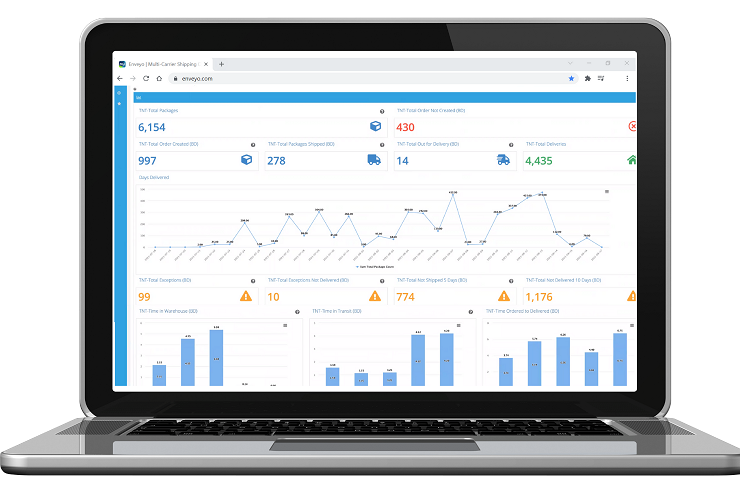
    Enveyo Alerting Time in Transit Dashboard

    Conclusion

    A seamless customer delivery experience post-purchase leads to increased trust, brand loyalty, and higher customer retention rates. By continuing the conversation with your customers after they leave your online store, you strengthen the relationship with your brand and increase customer loyalty.  

    Enveyo’s delivery experience management software, Alerting, is helping e-commerce shippers improve customer loyalty and increase sales. Request a demo to learn more.  

  • 5 Changes 3PLs Can Make to Boost Customer Satisfaction

    5 Changes 3PLs Can Make to Boost Customer Satisfaction

    Customer satisfaction has never been more important for third-party logistics (3PL) providers. Their brick-and-mortar and e-commerce customers want to offer a seamless delivery experience that gets products to consumers faster, more efficiently, and at the lowest cost. In this blog, we look at five ways 3PLs can help.

    When brick-and-mortar stores closed during the pandemic, e-commerce became essential for consumers to buy goods. People bought everything from cars to groceries from the comfort of their homes, and data indicates those shopping habits will continue.

    An ESET survey found that 70 percent of Americans are shopping more online than before the pandemic. And according to Mastercard, online sales jumped 54 percent in February 2021 from a year ago.

    With so many turning to online shopping, many shippers are also turning to 3PL providers to optimize their product fulfillment. Now, instead of competing on product or brand loyalty, companies are competing on customer delivery experience.

    Here’s how 3PLs can get the job done.

    5 Ways to Improve 3PL Customer Satisfaction


    1. Data Visibility

    In today’s world, consumers expect to receive packages in two days or less and at the lowest cost. And meeting that high standard requires better visibility into your shipping data.

    As a result, many 3PLs have started offering their customers in-depth dashboards that provide access to real-time data, including:

    • Parcel billing metrics, including accessorial and exception charges
    • Shipping time in transit
    • Carrier performance

    How critical is data visibility? Let’s put it this way. 3PLs that can’t provide this benefit will likely lose customers to providers that can. And if a customer asks you for their data, it’s a sign they’re shopping for a new 3PL partner.

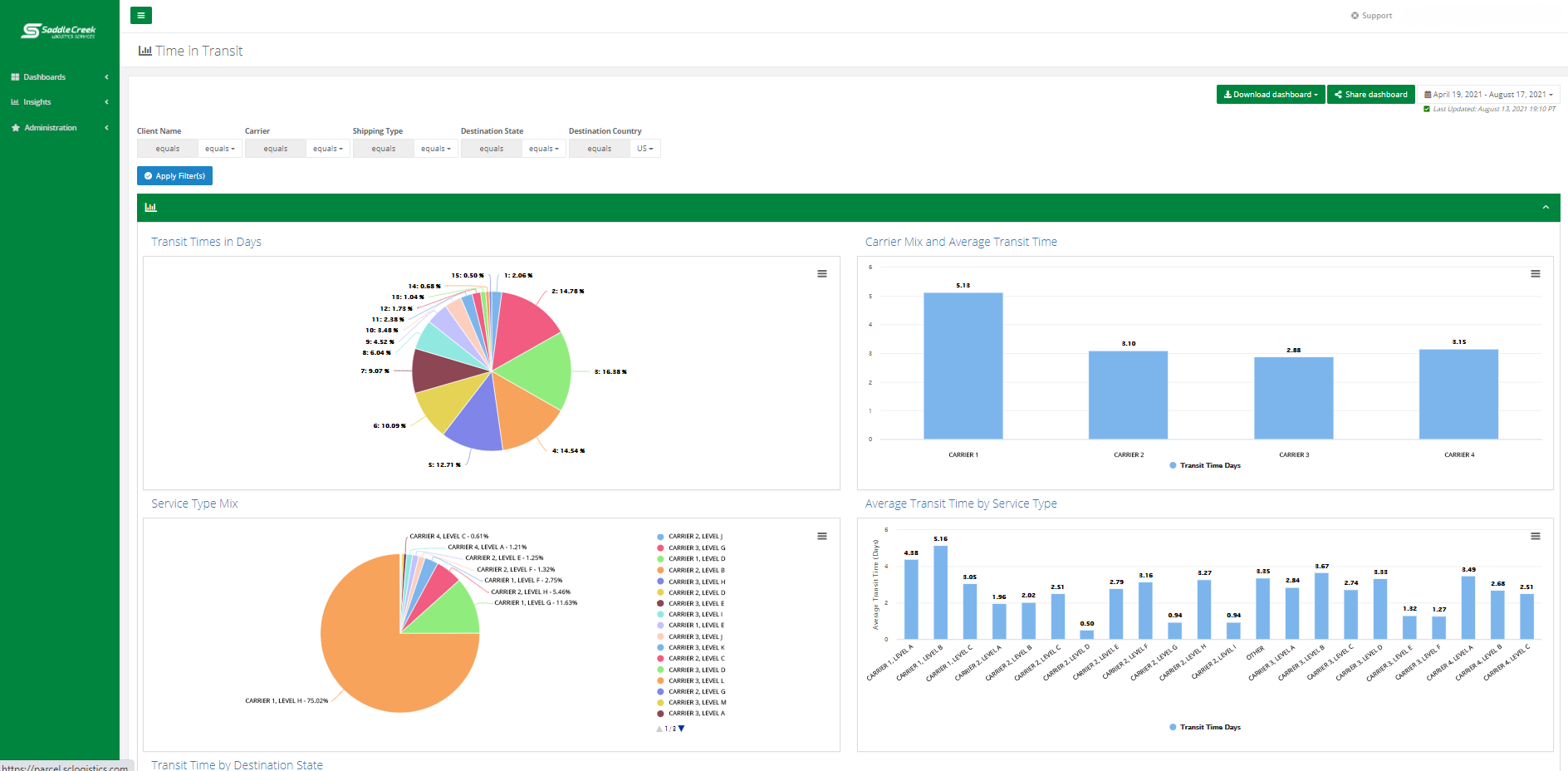
    Time in Transit Dashboard

    *Saddle Creek Time in Transit Dashboard Powered by Enveyo

    2. TMS Software

    Retailers and online stores need to find the best shipping service and lowest rate for each package. Otherwise, they can kiss their traditionally small margins goodbye.

    To ensure 3PLs can ship at the volume consumers demand, many companies are diversifying their carrier strategy and onboarding additional carriers at the national, regional, and final mile levels. As a result, 3PLs need a software application to manage it all and integrate with each carrier to carry out this strategy efficiently.

    Transportation management systems (TMS) enable shippers to automate an infinite number of rulesets to select the most efficient and cost-effective carrier, mode, and service for each package. This makes the 3PL’s job easier by removing time-consuming and manual interactions with carriers’ systems while keeping your retail and e-commerce clients happy with a delivery experience they can rely on.

    3. Customer Alerting

    When it comes to online shopping, real-time customer alerts play an essential role in the delivery experience. Consumers expect alerts when their order has been placed, shipped, delivered, as well as when unexpected delays occur. These alerts come as texts, emails or both. Not only is customer alerting a must-have in today’s e-commerce landscape, but it also serves as a dynamic marketing tool for 3PLs and their customers to promote products and services.

    With the right customer alerting system in place, consumers get real-time visibility into the order delivery process. This adds value to the 3PL customer competing for brand loyalty and the best delivery experience. 3PLs can also offer customer alerting as a service option to your customers, providing an additional revenue stream and added value.

    Delivery Experience Management Software

    4. Billing Management

    Billing management becomes more complex as your 3PL grows. For example, 3PLs shipping through multiple carriers with varying services and rates results in a vast number of carrier bills throughout the month.

    Not only do you have to pay those bills, but you must also bill back your customers, which can quickly get confusing the more customers and carriers you partner with. Even the smallest charges have an impact – missing parts, returns, failed delivery, and other problems, make it harder to send accurate bills to customers.

    Billing management software helps ensure each and every customer gets the right bill, and your customers want visibility into their charges. Leveraging a comprehensive, integrated reporting tool allows you to simplify carrier billing while providing your customers with a platform to view their business-specific data. Your customers will be happy knowing their bills are correct and justified, saving them the hassle of having to talk to a customer service representative to resolve a billing issue.

    Enveyo Insights Platform

    5. Expediting Proposals & Onboarding

    When customers compare 3PLs, they look for information on performance and rates. So the faster you can get that data to them, the better your chance of getting their business.

    Let’s start with rates. Since shipping volume determines rates, you need to ensure your potential customer will have enough business to justify the costs. To determine this, you need to integrate and evaluate your data with your customer’s so each of you can decide if there is a mutual fit.

    Modeling software makes it possible to utilize customer data to determine the most profitable approach for you and the customer. You can run scenarios around questions like, “How much money can I save this customer if they should partner with us, and how quickly can they get their return on investment?” and use modeling to see how it all plays out.

    It’s a win-win situation for both parties because it shows how each partner adds value to the other.

    Conclusion

    E-commerce shopping is more popular than ever, and it will only continue to grow. 3PLs must find new ways to help retail clients deliver a satisfying customer experience at every turn. Tools that provide better visibility, service optimization, alerting and forecasting will play a critical role in making this possible.

    Enveyo offers shipping and logistics management software to take your 3PL provider to the next level. Request a demo to learn more.

  • Saddle Creek Logistics Launches Enveyo-Powered Time-In-Transit Dashboard for Greater Parcel Shipping Visibility

    Saddle Creek Logistics Launches Enveyo-Powered Time-In-Transit Dashboard for Greater Parcel Shipping Visibility

    Saddle Creek Logistics Services Expands Parcel Analytics Reporting Suite with Enveyo

    Saddle Creek Logistics Services announced it is expanding its parcel analytics reporting suite to include a time-in-transit dashboard, powered by Enveyo. The new feature offers comprehensive visibility into delivery metrics to improve parcel management while controlling costs.

    “We launched our parcel analytics tool to offer shippers much-needed transparency into their parcel data and costs,” said Megan Rudolph, senior director of parcel operations at Saddle Creek. “With this new enhancement, shippers will also have full visibility into carrier performance, so they can ensure their parcel solution optimizes costs while still meeting the customer’s delivery expectations.”

    The Enveyo-powered Time In Transit Dashboard helps to guide business decisions by highlighting performance across the various delivery methods and parcel carriers that shippers offer to their customers. Clients implementing Saddle Creek’s dynamic carrier selection technology or adding a new facility can leverage the data to validate their strategy with these key performance indicators (KPIs) – cost and speed. The dashboard can also help to identify dips in on-time performance that need to be addressed with carriers directly.

    “The parcel market is constantly evolving. It’s critical to understand how carrier changes impact costs and delivery experience, but sourcing and interpreting that data tends to be a major challenge for shippers. We’re excited to make this information more accessible for our clients,” Rudolph explained.

    Populated with the user’s actual invoice and transit data, the web-based dashboard presents a clear picture of parcel activity. Users can view transit time and cost per piece by carrier, service type, destination and more. Data is uploaded across various dashboards with the option to filter by a user’s specified time frame (weekly, monthly, quarterly or annually).

    The new time-in-transit dashboard is now live and available to Saddle Creek’s parcel clients. The company manages approximately 45 million parcel shipments for clients annually.

    View the Saddle Creek Logistics Services press release here.

  • Enveyo Named to 2021 List of Great Supply Chain Partners by SupplyChainBrain

    Enveyo Named to 2021 List of Great Supply Chain Partners by SupplyChainBrain

    Enveyo, a leading Transportation Management System (TMS) and logistics optimization software provider, is proud to announce it has been named to the list of 100 Great Supply Chain Partners of 2021 by SupplyChainBrain 

    Hundreds of solution providers in all sectors of supply chain management were nominated for the annual listing during a six-month online poll. Supply chain professionals submitted nominations for partners whose technology, logistics, transportation, or consulting solutions have made a significant impact on their company’s efficiency, customer service, and overall supply chain performance.  

    “For nineteen years running, SupplyChainBrain has published our much-anticipated list of 100 Great Supply Chain Partners — a select group of companies whose customers recognize them for providing outstanding solutions and services,” says SupplyChainBrain publisher, Brad Berger. “This year’s field of nominees was highly competitive and overall excellent – coming from all sectors of supply chain management.”  

    Organizations across industries partner with Enveyo to optimize their parcel shipping spend and logistics operations. Enveyo’s cloud-based suite of logistics software, including Modeling, Insights, Cloudroute, and Audit products, has helped organizations achieve significant cost savings and efficiency gains. Today, Enveyo is the only multi-carrier parcel TMS provider to enable end-to-end supply chain visibility from predictive logistics modeling, shipping analytics & automation, to customer delivery experience management.  

    “We’re honored to be recognized by SupplyChainBrain as one of the 100 Great Supply Chain Partners,” says Coby Nilsson, Enveyo’s co-founder and CEO. “We want to thank our clients for recognizing our hard work and the impact our solutions have on their organization’s supply chain efficiency. This past year has posed many challenges for supply chain professionals worldwide. Our hats go off to all the organizations included on this list. We’re humbled to be part of the 2021 class.” 

    Enveyo will appear in the 2021 August issue of SupplyChainBrain magazine and on SupplyChainBrain.com as an honored member of this year’s 100 Great Supply Chain Partners. 

    To learn more about how Enveyo’s solutions increase supply chain efficiency, visit enveyo.com 

  • Enveyo’s Logistics Software Suite Helps CooperVision Save $4.7 Million in Contracted Shipping Costs

    Enveyo’s Logistics Software Suite Helps CooperVision Save $4.7 Million in Contracted Shipping Costs

    Enveyo, a leading Transportation Management System (TMS) and logistics software provider, today reported an implementation of cloud-based shipping analytics & optimization solutions Modeling, Insights, and Audit helped leading contact lens manufacturer, CooperVision, save more than $4.7 million in contracted shipping costs.

    CooperVision is the global leader in contact lenses, designing and manufacturing innovative, high-quality lenses with the widest range of prescription options. Headquartered in upstate Victor, New York, CooperVision services world-wide customers and looked to optimize their global fulfillment and supply chain needs, while also responding to consumer demand for two-day shipping without significant investment.

    CooperVision turned to Enveyo to implement its cloud-based suite of solutions and recommend next steps that would transform CooperVision’s shipping operations and reduce overall costs. Enveyo’s predictive analytics software, Modeling, business intelligence & integrated reporting tool, Insights, and carrier performance monitoring solution, Audit, set CooperVision on the path to optimize and streamline the global fulfillment of its contact lenses.

    The Enveyo logistics software implementation yielded CooperVision:

    • More than $4.7 million savings in base transportation costs
    • On-demand visibility into reporting of shipping actuals and carrier performance
    • Ongoing cost recovery through programmatic carrier audits
    • Improved customer satisfaction by implementing two-day residential shipping
    • Reduction in shipping spend of 16% while volume increased by 31%

    Implementing Enveyo’s suite of solutions into CooperVision’s technology stack enabled them to make data-driven decisions and introduce two-day residential shipping from a difficult geographical location while reducing shipping costs in the process. CooperVision’s shipping distribution shifted from 36% to 88% two-day service and ground shipping went from 60% down to 7%. During this time, CooperVision decreased its cost per shipment by 4% while the market’s published residential rates increased by 33%. By making these shifts, CooperVision decreased its parcel shipping spend by 16% overall despite a 31% increase in total shipping volume and a 200% jump in residential shipments.

    “Without Enveyo’s tools, this simply wouldn’t have been possible,” said Jim Fiorino, Director of Distribution for CooperVision. “We see Enveyo’s suite of tools as an ongoing critical component of our business. Their tools and reporting give us immediate and ongoing visibility that allows us to continually identify opportunities to optimize and introduce efficiencies.”

    Coby Nilsson, Enveyo’s Co-Founder and CEO said, “We’re proud to partner with CooperVision. Supply chain & logistics have seen incredible shifts over the last 18 months, and this implementation enabled CooperVision to turn the cost of doing business into a competitive advantage and has positioned them to keep driving growth for their business moving forward.”

    To learn more about CooperVision’s experience with Enveyo Modeling, Insights, and Audit, read the full case study. To learn more about Enveyo’s cloud-based suite of logistics software, visit enveyo.com.

  • Enveyo Named Supply & Demand Chain Executive’s 2021 Top Supply Chain Project

    Enveyo, a leading Transportation Management System (TMS) and logistics software provider, today announced Supply & Demand Chain Executive, the only publication covering the entire global supply chain, selected Enveyo as a recipient of the Top Supply Chain Projects Award for 2021.

    The Top Supply Chain Projects (formerly known as SDCE 100) spotlights successful and innovative transformation projects that deliver bottom-line value to small, medium, and large enterprises across a range of supply chain functions. These projects show how supply chain solution and service providers help their customers and clients achieve supply chain excellence and prepare their supply chains for success.

    Enveyo earned this year’s SDCE Top Supply Chain Projects Award for its implementation of cloud-based logistics software solutions ModelingInsights, and Audit for leading contact lens manufacturer, CooperVision. CooperVision selected Enveyo’s suite of solutions to optimize their carrier contract negotiation process and efficiently implement two-day residential shipping while reducing overall costs. The successful Enveyo software implementation yielded CooperVision savings of over $4.7 million in base transportation costs. CooperVision also reduced its shipping spend by 16% overall, despite a 31% increase in total shipping and a 200% jump in residential shipments. Jim Fiorino, Director of Distribution for CooperVision said, “Without Enveyo’s tools, this simply wouldn’t have been possible. We got the set of tools we needed to solve our shipping challenges and the right partner to help us navigate them.”

    “We’re proud to be selected as a Supply & Demand Chain Executive Top Supply Chain Project,” says Coby Nilsson, co-founder and CEO for Enveyo. “Our partnership with CooperVision reflects our supply chain efforts to transform the way technology drives logistics with big data strategy. Our carrier-agnostic platform enables companies to turn their shipping operations into a competitive advantage.”

    “The supply chain industry has been challenged with a host of supply chain disruptions over the last year. Yet, the winners on this list continued to re-tool and innovate,” says Marina Mayer, editor for Supply & Demand Chain Executive and Food Logistics. “Whether it be moving a customer to a cloud-based solution or implementing a more sustainable shipping option, these top supply chain projects reflect the supply chain industry’s strength and resilience to overcome disruptions and work better, smarter and more efficiently in the years ahead.”

    To learn more about how Enveyo is transforming the way technology drives logistics, visit enveyo.com.

    To view the full list of 2021 Top Supply Chain Project winners, visit sdcexec.com.

  • 5 Best Practices to Turn Your Multi-Carrier Parcel Shipping Operations into a Competitive Advantage

    5 Best Practices to Turn Your Multi-Carrier Parcel Shipping Operations into a Competitive Advantage

    Implementing a multi-carrier parcel shipping strategy is crucial to compete in today’s fast-paced environment. Let’s dive into how to turn that cost of doing business into a competitive advantage.

    The supply chain disruptions of 2020 have shifted consumer behavior forever. Consumers are buying everything from a tube of toothpaste to large home gym equipment without ever stepping foot in a brick & mortar store, and the volume of Direct-to-Consumer parcel shipments will continue to grow exponentially in 2021 and beyond. Pitney Bowes forecasts global parcel volume to likely more than double by 2026 to 220-262 billion parcels shipped annually.  

    With that growth comes great complexity. Shippers are faced with responding to consumer demand of 2-day shipping at little to no cost, competing on delivery experience over brand loyalty, and capacity restraints from carriers limiting shipping volume. And this is after the blood, sweat, tears, and dollars you poured into digital advertising to get the consumer to your website and make a purchase. Yikes. 

    While many were happy to see 2020 in the rearview mirror, shippers will continue to face these complex challenges and need to overcome them to stay competitive. In this blog post, we’ll cover five best practices for multi-carrier parcel shipping that will turn your shipping operations into a competitive advantage.  

    1. Let Big Data Guide Your Multi-Carrier Shipping Decisions

    Without clear visibility into your supply chain, it’s nearly impossible to control costs in today’s cutthroat omnichannel environment. Understanding where you make money and lose money at every step of the process is critical to success. Shippers need to gain insights into performance on a wide variety of data points to make sound shipping decisions and avoid eroding profitability. Some examples include: 

    • Cost analysis by carrier and zone
    • Carrier performance, including time in transit, exception rate, and other delivery experience-related metrics
    • Accessorial charge impacts, especially during peak season

    Each of these data points, and the dozens of others that supply chain managers need to track, are often found in disparate systems, and require a data analyst to consolidate, cleanse, and tell a story that their organization can act on. Every second counts in today’s fast-paced environment, and that includes the past to present data analysis & reporting that enables organizations to make competitive multi-carrier shipping decisions.  

    Leveraging a comprehensive comparative analytics software that integrates with your eCommerce, ERP, OMS, or other business systems will give you a true global view of your logistics environment and uncover opportunities that traditional tools are unable to identify. By leveraging Enveyo Insights analytics & reporting solution, America’s leading managed healthcare services provider gained complete visibility into their supply chain and reduced overall parcel shipping costs by 14%. 

    Read the case study to learn how.

    2. Model & Predict Outcomes to Future Scenarios Before Making Shifts

    Magic 8 Ball, If I open another distribution center closer to my customers, will customer satisfaction ratings and profits increase?” To stay competitive in today’s market, you need to model outcomes to future scenarios to reduce risk and better understand if you’re making sustainable business decisions before you make them. Whether small or large shifts in your shipping operations, any change will have an impact on customer satisfaction and ultimately, your bottom line. 

    Some of the scenarios predictive modeling is answering for shippers are:  

    • “Should I introduce other national or regional carriers into my multi-carrier shipping strategy?”
    • “How do I diversify my shipping strategy and maintain revenue bands & targets?”
    • “Based on my current shipping patterns and carrier discounts, should I re-negotiate my contracts?”
    • “Should I partner with a Third-Party Logistics (3PL) provider for more cost-effective fulfillment?

    Hindsight is 20-20, but looking ahead to model the impact of decisions you’re about to make will ensure you yield long-term gains with every move and remove the risk of making a costly mistake. Enveyo Modeling easily incorporates your actual shipping data into modeling scenarios that lets you measure downstream impact prior to execution.  

    Young Living, a worldwide leader in essential oils, leveraged Modeling to perform predictive analytics on implementing a subscription program for its customers. Modeling leveraged customer purchase data and Young Living’s shipping data to show company leadership with certainty that this would be a long-term profitable shift.


    3. Implement a Multi-Carrier Shipping Strategy & Automate Decision-Making

    2020 backed many shippers into a corner. Particularly those who standardized shipping with a single carrier. Carriers implemented capacity restrictions limiting the volume of parcels companies could ship, peak season surcharges were tacked on that ate away at shippers’ margin, and Guaranteed Service Refunds (GSRs) were suspended even when carriers didn’t meet their performance commitments. 

    Shippers need to implement a multi-carrier shipping strategy and diversify their parcel shipping business to ensure they don’t get stuck in the 2020 mud again. With adding variety also comes managing complexity of which shipper to leverage and at which mode and service to execute each shipment in the most cost-effective way without sacrificing the customer experience. Leveraging a robust multi-carrier parcel transportation management system (TMS) will help shippers:

    • Create shipping rule sets specific to the needs of their business
    • Automate those rule sets to ensure the most optimal shipping method is used for each package
    • Accelerate shipping processes and meet customer delivery expectations
    • Eliminate shipping mistakes caused by human error
    • Be agile when shipping carriers or intra-carrier rules need to quickly shift

    Consumer expectations have shifted, and the delivery experience is just as important as product quality. Consumers not only expect fast shipping at a low cost, but also real-time package tracking and shipment alerts. Shippers should look to parcel TMS solutionthat enable true end-to-end parcel visibility from shipping analytics & automation to customer delivery experience management. Enveyo’s Cloudroute software incorporates an advanced decision-making engine to act on shipping rules specific to the needs of your business as well as customer alerting when packages have been shipped with estimated date of delivery and real-time tracking.

    4. Audit Carrier Performance & Automate Refunds

    In a perfect world, every carrier would be able to deliver precisely against all contractual commitments. In reality, there are so many potential points of failure that it’s impossible to meet 100% of those obligations. In fact, studies have shown that up to 5% of shipping expenses are eligible for a refund due to carriers’ failure to meet these obligations. 

    2020 was a tough year for everyone, and on top of the various struggles shippers faced, the absence of carriers honoring GSRs when shipping obligations weren’t met was just another blow. However, as of April 5th and 6th, 2021, both FedEx and UPS respectively have reinstated GSRs for select services making carrier performance auditing a key component for a competitive multi-carrier parcel shipping strategy.  

    Whether you’re newly implementing carrier performance auditing or are re-evaluating your current audit processes, consider this: 

    • Manual audits are prone to human error, take longer to recover revenue, or can miss refund opportunities entirely. Implement a cloud-based audit solution that monitors carrier performance real time and automates refunds while reducing manpower on manual efforts.
    • When outsourcing your carrier auditing, many auditing companies take a percentage of the refund. Implement a solution in-house that doesn’t take a share of your recovered revenue so the money you’re owed doesn’t contribute to another company’s profits.

    Check out this case study detailing how leading contact lens manufacturer, CooperVision, added incremental dollars back to their bottom line without the investment of human capital.

    5. Standardize Your Multi-Carrier Shipping Software Stack

    Organizations that are executing on some or all of the best practices mentioned in this blog likely have a software solution or third-party consultant to execute against each task. While those solutions may get the individual jobs done, they are siloed, stitched together, legacy systems or processes that don’t enable true end-to-end supply chain visibility. Standardizing on one cloud-based multi-carrier shipping software suite enables organizations to efficiently analyze, model, automate, and audit their shipping operations with one solution.  

    Standardizing your multi-carrier shipping software stack will help you:

    • Reduce costs of multiple disparate systems and simplify budgeting
    • Scale quickly when new locations, distribution centers, or 3PL partners are introduced
    • Optimize operational resources to areas of your business that increase revenue
    • Remove the IT headache of software upgrades and ongoing maintenance across platforms
    • Simplify vendor relationships to one account management, customer & technical support team
    • Train users more efficiently, helping you get products to customers faster

    In today’s highly competitive, fast-paced supply chain, every second counts. Companies like Amazon have altered customer expectations for merchandise delivery and many businesses are struggling to remain competitive without over-spending. In order to compete, you must treat your supply chain as an integral part of the overall customer experience. Disparate solutions only compound the problem and are no longer effective in this environment.  

    Turn your multi-carrier shipping process into a competitive advantage and request a demo of Enveyo’s cloud-based logistics software platform.