Enveyo Stage

Blog

  • Variable vs Fixed: Building a Winning Carrier Capacity Strategy in Q4

    Variable vs Fixed: Building a Winning Carrier Capacity Strategy in Q4

    As peak ramps up, shipping leaders face a critical question: Are we locked into the right carrier capacity strategy, or do we need to pivot now before it’s too late?

    Get this decision right, and you’ll handle the holiday surge smoothly while protecting margins. Get it wrong, and you’re either scrambling for capacity at astronomical rates or stuck paying for shipping volume you never use.

    The answer isn’t one-size-fits-all. It’s about understanding your actual cost structure and risk tolerance.

    Fixed Capacity: The Contracted Rate Play

    Fixed capacity is the traditional move: negotiate your rates, commit to volume, and lock in guaranteed space for peak.

    Sounds great in theory… until the numbers don’t line up.

    The hidden costs:

    • Paying annual minimums whether you use them or not
    • Missing out when spot rates dip below your locked-in rate
    • Penalties for falling short on commitments
    • Zero flexibility to pivot when performance slips

    When it works:
    You’ve got predictable volume. Your peak-to-trough ratio is under 2:1. You need guaranteed space when everyone else is fighting for trailers.

    If you’re consistently shipping 80% of contracted minimums in your slow months and hitting 100%+ during peak, you’re winning. But if you’re sitting at 40% utilization before the surge? You’re paying for capacity you’ll never touch.

    Variable Capacity: The Flex Play

    Variable capacity is all about agility: using the spot market, regional carriers, and on-demand options that flex with your volume.

    The trade-offs:

    • You’ll pay more during peak surges
    • You lose priority when carriers get tight
    • Forecasting becomes a headache
    • Managing multiple partners adds operational noise

    When it works:
    Your peak season runs 3x your baseline. Demand fluctuates year to year. You’re scaling fast and can’t afford to be handcuffed by contracts.

    You’ll pay a premium per shipment, but you only pay for what you actually move. That flexibility is worth gold when forecasts shift or the market flips overnight.

    The Hybrid Reality Most Shippers Face

    Let’s be real – almost no one runs 100% fixed or 100% variable anymore.

    The best shippers build hybrid models:

    • Lock in enough contracted capacity to cover your base + ~20–30% surge
    • Layer in spot market and regional carriers for everything above that

    The art (and the math) is finding that breakpoint—the exact moment where fixed becomes cheaper than variable. And that’s impossible without visibility into your actual data.

    Running the Numbers That Matter

    Variable vs fixed capacity modeling breaks down when you’re guessing at shipping costs. You need to track:

    • Carrier contract utilization rates by month and service level across your entire network
    • Actual landed costs, including accessorial charges, fuel surcharges, and dimensional weight penalties that blow up your “contracted rate”
    • Break-even analysis showing at what volume level contracted rates become cheaper than spot market pricing
    • Peak rate multipliers that reveal how much more each incremental shipment costs during carrier capacity crunches

    Most shipping leaders have a rough sense of these numbers. But “rough sense” leads to bad decisions that can cost millions.

    Modern shipping analytics platforms pull this data automatically from your TMS and carrier invoices. You can see real-time carrier contract performance, compare actual all-in shipping costs across carriers, and model different scenarios before committing to annual carrier agreements.

    The Data You’re Missing

    The biggest mistake in capacity modeling? Looking only at base rates while ignoring the variables that actually drive costs.

    • Dimensional weight
    • Residential surcharges
    • Address corrections
    • Weekly fuel adjustments
    • Carrier-specific peak fees

    Your “contracted rate” of $8.50 per package might actually cost $12.30 when you factor in all the accessorials. If you’re not seeing that data in one place, you’re building strategy on fiction.

    The Gut Check Questions

    Before you lock in more volume or ride out your current plan, ask yourself:

    • Do I know my true all-in cost per package, by carrier and service level?
    • Can I see utilization rates month-to-month?
    • Can I model a 20% swing in volume—up or down—and still protect margin?

    If you’re hesitating on any of these, you don’t have enough data visibility to make smart capacity decisions.

    Making the Call

    Variable vs fixed capacity modeling isn’t about picking one strategy and sticking with it forever. It’s about understanding your true shipping costs, knowing your breakpoints, and having the flexibility to adjust as your business evolves.

    Build your model on real data, not guesswork. Test multiple scenarios. And make sure you can track actual performance in real-time as peak season accelerates.

    The winners this peak season aren’t the ones with perfect spreadsheets—they’re the ones who see their data clearly, know their breakpoints, and can pivot mid-peak before problems turn into losses.

    Data drives confidence. Visibility drives control. And in Q4, control is everything.

  • Enveyo Recognized as a 2025 Inc. Power Partner Award Winner

    Enveyo Recognized as a 2025 Inc. Power Partner Award Winner

    The annual list recognizes the leading B2B companies that have proven track records of supporting entrepreneurs and helping companies grow.

    Provo, Utah, November 5, 2025 Enveyo is proud to announce its recognition on the Inc. Power Partner Awards. The prestigious list honors B2B organizations that have proven track records supporting entrepreneurs and helping businesses grow.

    Companies on the Inc. Power Partner list received top marks from clients for being instrumental in helping leadership navigate the dynamic world of startups. These B2B partners support entrepreneurs across various facets of the business, including hiring, compliance, infrastructure development, cloud migration, fundraising, logistics and more, allowing founders to focus on their core missions.

    “The entrepreneurial journey and community are core to Inc.’s mission, and it’s a true honor to celebrate this year’s Inc. Power Partners — the companies dedicated to helping businesses and entrepreneurs,” says Bonny Ghosh, editorial director at Inc. “Whether they’re coordinating complex marketing campaigns or reliably supporting the day-to-day infrastructure of growing companies, these honorees aren’t simply B2B providers — they are true partners in helping businesses grow and succeed.” 

    “Being recognized as a 2025 Inc. Power Partner for the second consecutive year reinforces what we’ve always believed: when you empower businesses with the right data and technology, remarkable things happen,” says Coby Nilsson, Enveyo’s CEO & Co-Founder. “Our mission has always been to eliminate the complexity that holds logistics teams back and give them the tools to make confident, business-transforming decisions. This award reflects the trust our clients place in us, and we’re excited to continue innovating alongside them.”

    Enveyo’s mission is simple — enable businesses to make business-transforming shipping decisions by leveraging comprehensive data & integrated systems. Shippers and 3PLs of all sizes and across industries leverage Enveyo technology to power streamlined logistics operations and realize substantial cost savings.

    Enveyo’s advanced logistics technology platform empowers organizations to:

    • Unify data across their entire logistics ecosystem – Seamlessly ingest unlimited data from any system in any format, breaking down silos and streamlining technology investments
    • Make faster, smarter decisions – Access real-time dashboards with customizable views of shipment performance and cost analytics that drive immediate action
    • Optimize every shipment automatically – Deploy intelligent business rules that select the ideal carrier, service level, and rate for each delivery, adapting instantly to market changes
    • Elevate customer satisfaction – Deliver proactive, real-time shipping notifications throughout the delivery journey, building trust and strengthening brand loyalty
    • Protect profit margins – Automatically audit carrier performance against contract terms, catch billing errors, and recover overcharges
    • Accelerate strategic growth – Leverage complete, accurate logistics intelligence to identify opportunities and outpace competitors

    Learn more about how Enveyo’s suite of logistics optimization solutions help shippers and 3PLs of all sizes move their logistics forward at enveyo.com.

    For more information or to view the complete list of honorees, visit https://www.inc.com/power-partner-awards.

    About Enveyo

    Enveyo is the leading provider of logistics data management, visibility, and shipping optimization software, helping 3PLs and shippers of all sizes like CooperVision, Zazzle, Barrett Distribution, GEODIS, and Saddle Creek Logistics, move their logistics forward through data-driven technology. From shipment analytics and automated carrier selection to post-purchase delivery experience management and freight auditing, Enveyo is the only suite deploying solutions across the logistics lifecycle. Powered by a robust, enterprise data management platform, Enveyo Insights, Modeling, Cloudroute, Alerting, and Audit solutions enable organizations to make business-transforming shipping decisions. To learn more about how Enveyo moves logistics forward, visit enveyo.com.

    About Inc. 

    Inc. is the leading media brand and playbook for the entrepreneurs and business leaders shaping our future. Through its journalism, Inc. aims to inform, educate, and elevate the profile of its community: the risk-takers, the innovators, and the ultra-driven go-getters who are creating the future of business. Inc. is published by Mansueto Ventures, along with fellow leading business publication Fast Company. For more information, visit www.inc.com

  • How New USPS Peak Surcharges Are Eating Into Your Bottom Line (And What to Do About It)

    How New USPS Peak Surcharges Are Eating Into Your Bottom Line (And What to Do About It)

    Every holiday season, USPS implements temporary peak surcharges that impact shipping costs across the board. These surcharges typically run from early October through mid-January, adding expenses across multiple service levels during the industry’s busiest and most critical period.

    For shippers and 3PLs managing high-volume operations, preparing for these increases and implementing strategic responses is essential for maintaining margins, cost avoidance, accrual reporting, meeting customer expectations, and protecting profitability when it matters most.

    Understanding Peak Season Pricing

    Holiday surcharges affect Priority Mail, Priority Mail Express, USPS Ground Advantage, Parcel Select, and Parcel Select Lightweight services. The increases vary by package size and service type, and dimensional weight pricing typically applies during this period—meaning packages are priced based on size rather than actual weight when dimensional weight is greater.

    This particularly impacts lightweight but bulky items like apparel boxes, cosmetics, or packaged home goods, where the box size drives the cost more than what’s inside.

    The Financial Reality for High-Volume Shippers

    For shippers moving thousands of packages daily, peak surcharges create substantial cost exposure. Commercial shippers face surcharges of $2.25 per package for Priority Mail and Ground Advantage packages in Zones 1-4 weighing 26-70 pounds, with costs escalating for longer zones and expedited services.

    Consider the math: A 3PL shipping 5,000 packages per day at an average surcharge of just $0.75 per package accumulates nearly $400,000 in additional costs over the 15-week peak period. Even moderate-volume shippers processing 1,000 daily packages face roughly $80,000 in surcharge exposure. These aren’t rounding errors—they’re line items that can swing quarterly profitability.

    The extended timeframe compounds the challenge. With surcharges spanning October through mid-January, there’s minimal opportunity to shift volume outside the peak window if you’re supporting retail, e-commerce, or seasonal fulfillment operations. Success requires proactive cost management, not reactive scrambling when invoices arrive.

    Risk Mitigation Strategies for Shippers

    • Optimize your packaging: Review package dimensions to minimize dimensional weight charges. Even small reductions in box size can move packages into lower pricing tiers. Conduct regular packaging audits well before peak season begins.
    • Shift volume strategically: Encourage early holiday shopping or ship non-urgent inventory before surcharges take effect. Post-holiday returns and exchanges can be timed to avoid the highest-cost periods when possible.
    • Diversify carrier mix: Evaluate competitive rates from regional carriers or consolidators for specific lanes. Peak surcharges aren’t uniform across carriers, and some routes may offer better economics with alternative providers.
    • Adjust pricing transparently: Update shipping fees or minimum order thresholds for free shipping during the surcharge period. Customers generally accept holiday shipping premiums when communicated clearly and in advance.
    • Automate rate optimization: Use shipping software that calculates dimensional weight and compares carrier rates automatically for every order. Real-time rate shopping across carriers captures savings at scale without adding manual steps to your fulfillment process.
    • Analyze your shipping profile: Review historical data to identify your highest-cost lanes, weight ranges, and service types. Understanding where surcharges hit hardest enables targeted mitigation—whether that’s packaging changes for specific SKUs or carrier switches for certain zones.
    • Model your peak season exposure. Project surcharge costs based on your historical shipping patterns—volumes by zone, weight distribution, and service mix. Data-driven forecasting helps you budget accurately and prioritize which mitigation strategies deliver the highest ROI for your specific operation.

    3PL Considerations for Holiday Success

    For 3PLs, peak surcharges create both operational complexity and client management challenges that require a structured approach to protect relationships and margins.

    • Communicate costs early and transparently: Inform clients about pass-through costs months before surcharges take effect—not when invoices arrive. Clear advance communication positions you as a strategic partner, not a cost surprise.
    • Structure billing for clarity: Implement surcharge line items in your billing that mirror the carrier structure. Itemized costs help clients understand true cost drivers and budget accordingly, reducing disputes and building trust. Consider technology that implements custom billing rules that can take effect automatically during a certain timeframe to provide incentivized pricing by customer.
    • Leverage rate prescriptive shipping technology: Deploy shipping platforms that calculate dimensional weight and compare multi-carrier rates in real-time while providing automated notifications when cost avoidance thresholds are met, carrier performance wavers, and more. Automated decisioning at scale eliminates manual work and captures savings across thousands of daily shipments.
    • Model client-specific impact: Analyze each client’s historical shipping patterns to project their peak season exposure. Proactive modeling enables consultative conversations about mitigation strategies tailored to their specific volumes, zones, and service mix.
    • Centralize carrier data and performance metrics. Consolidate shipping data across all clients and carriers into a single view that reveals patterns, cost drivers, and service failures. Unified analytics enable you to identify optimization opportunities at scale and have data-backed conversations about carrier mix adjustments during peak periods.
    • Streamline invoice reconciliation and pass-through accuracy. Automate the matching of carrier invoices to customer billing with detailed surcharge breakdowns at the service and zone level. Precise reconciliation reduces billing errors, accelerates invoicing cycles, and eliminates margin leakage from unaccounted fees.

    Planning for Peak Season Success

    Holiday surcharges are a predictable variable, which means they’re manageable with proper preparation. The shippers and 3PLs that maintain profitability during peak season are those that plan early, optimize operations continuously, and communicate proactively with customers and clients.

    Technology becomes critical during peak periods. Shipping platforms that automatically calculate dimensional weight and compare multi-carrier rates in real-time enable optimal decisions at scale without manual intervention for every shipment.

    Review historical shipping patterns to model financial impact. Implement mitigation strategies before peak pricing begins. Test packaging changes and carrier alternatives during lower-volume periods to ensure smooth execution when volume spikes.

    The difference between a profitable and painful holiday season often comes down to preparation. Start planning, execute strategically, and turn a cost challenge into a way to win.

  • Enveyo Partners with Passport to Deliver Data-Driven Intelligence for Global Shipping

    Enveyo Partners with Passport to Deliver Data-Driven Intelligence for Global Shipping

    Provo – UT, October 20, 2025 — Enveyo, the leading provider of logistics data management, visibility, and shipping optimization software, today announced a new partnership with Passport Global Inc., a leading global ecommerce solutions provider. Together, Enveyo and Passport are equipping ecommerce brands and 3PLs with the intelligence and infrastructure needed to make smarter, data-driven shipping decisions from checkout to delivery—and beyond borders.

    The partnership integrates Enveyo’s Cloudroute platform with Passport’s international shipping, compliance, and localization solutions. This collaboration extends Enveyo’s mission to eliminate complexity in parcel logistics at the global level, giving brands and logistics providers greater visibility into supply chain performance, optimized carrier selection, reduced costs, and improved delivery outcomes—all while ensuring a transparent customer experience.

    “At Enveyo, we eliminate complexity in parcel logistics by transforming fragmented shipping data into actionable intelligence that drives cost savings and operational efficiency,” said Nate Endicott, SVP of Growth at Enveyo. “Partnering with Passport extends that mission globally. Together, we’re giving ecommerce brands and 3PLs the visibility and control they need to manage cross-border logistics with precision and scale.”

    The partnership is already delivering results for leading 3PLs like Capacity LLC, who leverage both platforms to support their clients’ global expansion strategies.

    Passport is a great solution for our brands expanding into foreign markets like the UK and the European Union,” said Kevin Bernick, VP of Business Development at Capacity. “Their solutions are top-of-the-line, but they also do an incredible job of educating the client about the ins and outs of a very complex process. I love recommending Passport to our brands.”

    Data and visibility are critical to creating the best possible delivery experience for brands and their customers,” said Alex Yancher, CEO & Co-Founder of Passport. “By combining Enveyo’s analytics and optimization tools with Passport’s international network, we’re giving both brands and 3PLs the intelligence and infrastructure to make smarter shipping decisions and grow globally with confidence.”

    This partnership represents a natural extension of Enveyo’s commitment to moving logistics forward through data-driven technology. By combining Enveyo’s enterprise data management platform with Passport’s global infrastructure, the collaboration creates a comprehensive solution for brands navigating the complexities of international commerce.

    For more information about Enveyo’s full suite of logistics solutions, visit enveyo.com.

    About Enveyo

    Enveyo is the leading provider of logistics data management, visibility, and shipping optimization software, helping 3PLs and shippers of all sizes like Capacity LLC, CooperVision, Zazzle, Barrett Distribution, GEODIS, and Saddle Creek Logistics, move their logistics forward through data-driven technology. From shipment analytics and automated carrier selection to post-purchase delivery experience management and freight auditing, Enveyo is the only suite deploying solutions across the logistics lifecycle. Powered by a robust, enterprise data management platform, Enveyo Insights, Modeling, Cloudroute, Alerting, and Audit solutions enable organizations to make business-transforming shipping decisions. To learn more about how Enveyo moves logistics forward, visit enveyo.com.

    About Passport

    Founded in 2017, Passport Global Inc is a leading global ecommerce solutions provider, empowering brands like Dolls Kill, Ridge, Ogee, OneSkin, and HexClad to grow profitably and confidently in over 180 countries. Combining innovative technology, global logistics, and expert compliance, Passport delivers the right solutions for the right markets at every stage of global growth. From cross-border shipping to in-country enablement services and licensed customs brokerage, Passport provides a seamless, compliant, and flexible experience that helps DTC brands unlock their full international potential. To learn more, visit passportglobal.com.


  • FedEx and UPS 2026 General Rate Increases: Strategic Impact on Shippers and 3PLs

    FedEx and UPS 2026 General Rate Increases: Strategic Impact on Shippers and 3PLs

    The annual General Rate Increase (GRI) announcements from FedEx and UPS continue to be pivotal moments for supply chain professionals. As we look ahead to 2026, both carriers are implementing rate adjustments that will significantly impact shipping costs and logistics operations. Here’s what shippers and third-party logistics providers (3PLs) need to know about the upcoming changes.

    FedEx 2026 GRI: Key Details and Strategic Shifts

    Base Rate Increases

    FedEx has announced a 5.9% average increase across its standard list rates for U.S., U.S. export, and U.S. import services, effective January 6, 2026. However, this headline figure tells only part of the story.

    Service-Specific Impacts

    • Next-day air services (Priority and Standard Overnight) align closely with the 5.9% average
    • Two-day air services (2nd Day Air AM and 2nd Day Air) face increases significantly above 5.9% across all weight categories
    • FedEx Ground rates vary by zone, with Zone 2 seeing 5.6% increases while Zone 7 experiences 6.8% hikes

    Critical Surcharge Changes

    The real financial impact extends beyond base rates through targeted surcharge increases:

    Bulky Package Surcharges:

    • Large Package Surcharge increasing by $2.50 to $46 in 2026
    • This represents a continuation of aggressive pricing for oversized items

    Clearance Entry Fees:

    • $9.75 for shipments valued $0-$200
    • $19.50 for shipments valued $200.01-$800

    Pickup Structure Changes:

    • New pricing structure for parcel pickups effective August 18, 2025
    • Additional fees impacting regular pickup customers

    Network 2.0 Integration Effects

    FedEx’s ongoing Network 2.0 initiative to merge Express and Ground operations is driving strategic rate positioning, with differential zone pricing reflecting network optimization goals.

    UPS 2026 GRI: Competitive Positioning and Rate Strategy

    Matching Competitive Strategy

    UPS is expected to maintain its pattern of matching FedEx with a 5.9% average increase, though specific 2026 details are still emerging based on their announcement timing.

    Historical Pattern Analysis

    Based on recent trends, UPS typically:

    • Announces GRI details in October for the following year
    • Implements increases in late December (typically December 23rd)
    • Matches FedEx’s average percentage while targeting different service categories

    Expected Focus Areas

    Industry analysts predict UPS will continue targeting:

    • Ground commercial services with above-average increases
    • Additional Handling Charges (AHC) and Large Package Surcharges (LPS) escalation
    • Area Surcharge expansion to additional ZIP codes

    Strategic Impact on Shippers

    Budget Planning Implications

    The 2026 GRIs will impact shippers through multiple vectors:

    Direct Cost Increases:

    • Base rate increases of 5.9% minimum across most services
    • Disproportionate impact on two-day air services and long-zone Ground shipments
    • Surcharge escalation often exceeds base rate increases

    Service Mix Optimization:

    • Growing cost differential between service levels
    • Pressure to shift from premium services to ground alternatives
    • Zone-skipping strategies are becoming more critical for cost management

    Contract Negotiation Leverage:

    • Reduced negotiating power as both carriers maintain pricing discipline
    • Focus is shifting to surcharge mitigation rather than base rate discounts
    • Increased importance of alternative service agreements

    Sector-Specific Impacts

    E-commerce Shippers:

    • Residential delivery surcharges are continuing in an upward trend
    • Peak season pricing pressure is increasing year-over-year
    • Last-mile cost optimization is becoming essential

    B2B Shippers:

    • Commercial ground services are facing above-average increases
    • Bulk shipping advantages are eroding through surcharge escalation
    • Regional carrier alternatives are gaining attractiveness

    International Shippers:

    • Export/import services maintaining 5.9% baseline increases
    • Customs clearance fees adding operational complexity
    • Alternative international service providers becoming competitive

    3PL Strategic Response Framework

    Client Communication Strategy

    3PLs must proactively address rate increases through:

    Transparent Cost Modeling:

    • Detailed breakdowns of base rate vs. surcharge impacts
    • Service-specific cost projections by shipping profile
    • Alternative carrier cost comparisons

    Value-Added Solutions:

    Operational Adaptations

    Carrier Portfolio Diversification:

    • Expanding relationships with regional carriers
    • USPS integration for specific shipping profiles
    • Alternative last-mile delivery partnerships

    Technology Investment Priorities:

    Client Service Enhancement:

    • Proactive rate impact analysis
    • Monthly shipping cost reporting
    • Strategic shipping consultation services

    Mitigation Strategies for 2026

    Mitigation Strategies for 2026 GRI increases

    Industry Outlook

    Market Dynamics

    The 2026 GRIs reflect several key industry trends:

    • Margin protection prioritized over volume growth
    • Infrastructure investment costs passed through to customers
    • Labor cost inflation driving operational expense increases
    • Competitive alignment reducing shipper negotiating power

    Future Predictions

    Industry experts anticipate:

    • Continued 5-6% annual increases through 2027
    • Accelerating surcharge growth outpacing base rates
    • Increased carrier selectivity in service offerings
    • Growing importance of alternative delivery networks

    Conclusion

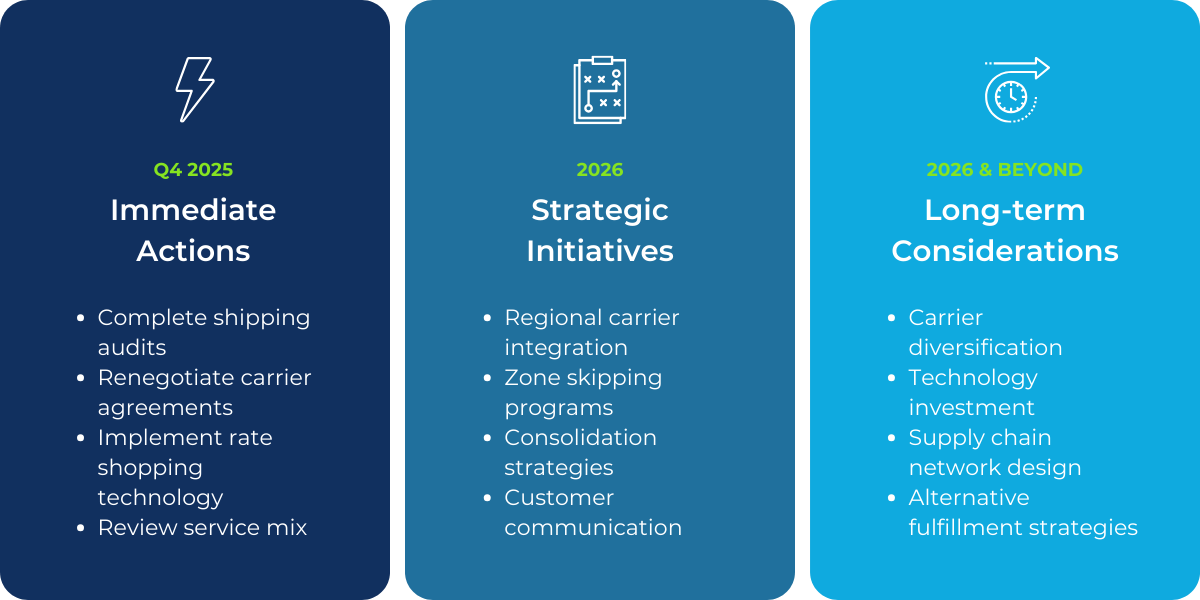
    The 2026 FedEx and UPS GRIs represent more than routine annual adjustments—they reflect fundamental shifts in carrier strategy and market dynamics. Shippers and 3PLs must move beyond reactive cost absorption to proactive strategic adaptation.

    Success in 2026 will require comprehensive shipping optimization, carrier diversification, and technology-enabled cost management. Organizations that treat these rate increases as catalysts for operational transformation will maintain a competitive advantage, while those pursuing status quo approaches will face margin compression and service limitations.

    The key is immediate action: conducting thorough shipping audits, exploring alternative carrier relationships, and implementing technology solutions before the January 2026 effective dates. The organizations that begin this process now will be best positioned to navigate the evolving shipping landscape successfully.

  • Peak Season Shipping: How High-Volume Shippers Beat the Rush

    Peak Season Shipping: How High-Volume Shippers Beat the Rush

    Peak season shipping has evolved into retail’s most demanding operational challenge, where success hinges on quick decisions and strategic preparation. For high-volume shippers, shipping tens of thousands of packages daily, the holiday surge creates a perfect storm of capacity constraints, skyrocketing costs, and service disruptions that can destroy quarterly profits in mere weeks.

    The stakes have never been higher. The largest three national parcel carriers — FedEx, UPS and USPS — each struggled with on-time performance in the peak period of 2024, while U.S. retailers are anticipating record import volumes for this peak season, with sustained high import volumes exceeding 2 million TEUs monthly throughout the season.

    The High-Volume Shipper Reality Check

    Unlike smaller operations, enterprise retailers face exponentially complex challenges during peak season. When you’re processing 50,000+ packages per day, a 1% increase in shipping costs translates to millions in annual impact. More critically, the operational complexity multiplies across every dimension of your shipping network.

    The peak season presents a unique set of challenges for businesses, including a shorter timeframe, supply chain disruptions, labor shortages, and increased shipping costs. For high-volume shippers, these challenges compound into existential threats to customer satisfaction and profitability.

    The difference between surviving and thriving during peak season comes down to one factor: preparation. Retailers who treat peak season as an operational fire drill consistently underperform those who implement strategic, data-driven approaches months in advance.

    Critical Peak Season Landmines for Enterprise Retailers

    Dynamic Peak Surcharges Hit Hardest

    The 2024 peak season introduced unprecedented surcharge complexity specifically targeting high-volume shippers. UPS charges apply to customers who ship more than 20,000 residential packages during a calculation week, varying throughout the demand period depending on how much you ship in a week over your baseline.

    FedEx escalated the pressure even further. This fee adjusts dynamically every week, ranging from $1.45 to $8.25 per package, based on the shipper’s volume deviation from their baseline shipping activity. For a retailer shipping 100,000 packages weekly, these surcharges can add $825,000 to weekly shipping costs alone.

    The baseline calculation creates a particularly vicious trap. Carriers establish your baseline during low-volume summer months, then penalize you for the very growth that defines successful retailers. This means your peak season success becomes the foundation for next year’s penalties.

    Capacity Rationing Becomes the New Normal

    Traditional carrier relationships provide little protection during peak season capacity crunches. Major carriers now implement strict volume limitations that can shut down your primary shipping channels overnight, forcing immediate scrambling for alternative solutions.

    Increased volumes can lead to congestion at ports and airports, causing delays that ripple through the supply chain. This congestion can create cascading failures across your entire fulfillment network, where delays in one region impact inventory positioning and customer expectations nationally.

    The challenge extends beyond simple capacity availability. When your primary carriers cap your volume, you’re forced into spot-market pricing with regional carriers who lack the infrastructure, tracking capabilities, and service level guarantees your customers expect.

    Service Performance Collapse

    Peak season consistently exposes the gap between carrier marketing promises and operational reality. While carriers promote average performance metrics, high-volume shippers may experience dramatic variation in service quality across different lanes, regions, and package characteristics.

    The performance degradation hits enterprise retailers particularly hard because customer expectations remain constant regardless of seasonal challenges. When you’re promising two-day delivery to millions of customers, carrier excuses don’t restore lost customer relationships or prevent negative reviews.

    Invoice Auditing Becomes Mission-Critical

    Peak season transforms billing from routine bookkeeping into strategic cost management. The complexity explosion during surge periods creates perfect conditions for revenue leakage:

    • Emergency surcharges appear without advance notice across multiple carrier networks
    • Accessorial fees multiply exponentially as carriers implement additional handling requirements
    • Zone skipping charges get applied inconsistently, creating billing unpredictability
    • Fuel surcharge variations compound across millions of packages

    FedEx announced 2025 peak season surcharges that are costlier than last year and feature updated demand-based fees for shippers to navigate. Traditional post-shipment auditing approaches fail completely during peak season because the volume and complexity overwhelm manual review processes.

    Strategic Solutions That Actually Work

    Implement Predictive Capacity Modeling

    Shippers need sophisticated “what-if” scenario planning that models various peak season demand patterns months in advance. This predictive capability allows shipping managers to identify potential bottlenecks and prepare alternative routing strategies before network failures occur.

    Effective capacity modeling quantifies the financial impact of different scenarios, enabling data-driven decisions about carrier diversification and alternative transportation investments. This proactive approach prevents the reactive capacity scrambling that destroys peak season profitability.

    Build Unified Operations Intelligence

    Successful peak season operations consolidate all shipping intelligence into one actionable platform. Instead of managing fragmented data from multiple carrier portals and internal systems, shippers need comprehensive visibility across all carriers, transportation options, and fulfillment locations.

    This unified view enables real-time decision-making when peak season pressures mount. When your primary carrier hits capacity limits, you need immediate visibility into which regional carriers offer available capacity in specific lanes, what their current performance looks like, and how their rates compare to your alternatives.

    Deploy Real-Time Financial Protection

    Peak season demands automated auditing capabilities that catch billing discrepancies as they occur, not weeks later during traditional invoice reviews. High-volume retailers shipping hundreds of thousands of packages daily need systems that deliver:

    • Overcharge detection across carrier invoices
    • Accessorial fee validation against contracted rates
    • Exception alerts for unusual billing patterns

    These automated auditing systems prevent revenue leakage by identifying overcharges before they compound across massive daily shipments. 

    Create Custom Performance Analytics

    Retailers cannot rely on carrier-provided average performance metrics for peak season planning. Instead, they need custom analytics that reflect their specific service requirements, package characteristics, and customer expectations.

    Granular performance and financial analytics reveal which carriers consistently underperform in specific regions or lanes, enabling strategic capacity allocation decisions. This performance data also provides crucial leverage during carrier negotiations and service level discussions.

    The Peak Season Transformation

    The most successful shippers treat peak season as a strategic opportunity rather than their greatest challenge. By implementing predictive planning, unified operations intelligence, and real-time financial controls, these retailers transform peak season from a profit-threatening period into a revenue driver that supports long-term growth.

    The key lies in recognizing that peak season success requires year-round preparation and investment in the right technology solutions. Shippers who wait until October to address peak season challenges have already lost the battle.

    Rather than a few concentrated weeks, the 2025 peak period will see elevated order volumes across multiple months. This extended peak season reality demands operational excellence that extends far beyond traditional holiday planning.

    The retailers who emerge stronger from peak season are those who view it as the ultimate test of their operational sophistication. They invest in the systems, processes, and intelligence needed to turn peak season volatility into measurable business value.

  • Enveyo Partners with APC Postal Logistics to Expand Global Shipping Options for Enterprise Customers

    Enveyo Partners with APC Postal Logistics to Expand Global Shipping Options for Enterprise Customers

    Provo, UT, August 19, 2025 – Enveyo, the leading logistics data and optimization provider, today announced a strategic partnership with APC Postal Logistics, a privately-owned eCommerce leader in global delivery and technology solutions. This technical integration provides Enveyo’s enterprise customers seamless access to APC’s international delivery services directly through the Cloudroute platform.

    The partnership addresses growing demand from Enveyo’s customer base for expanded global shipping capabilities. Through this integration, brands and 3PLs can now access APC Postal Logistics’ international services without custom implementation, removing traditional barriers to cross-border expansion.

    “Our customers have been successfully managing international logistics through Enveyo for 15+ years, but the speed of global commerce calls for options and APC is a prominent player,” said Nate Endicott, SVP of Growth at Enveyo. “This integration with APC Postal Logistics gives our customers immediate access to specialized cross-border services without the traditional implementation barriers. It’s another example of how we’re continuously expanding options while maintaining the seamless, data-driven experience our platform is known for.”

    The integration leverages Enveyo’s intelligent multi-carrier shipping platform to provide customers with APC’s full suite of international capabilities, including DDP and DDU delivery options, automated duty and tax calculation, product compliance management, and global logistics expertise. This combination enables enterprise shippers to expand internationally with greater confidence and operational efficiency.

    “This new integration with APC Postal Logistics through Enveyo is a game-changer for our brands and 3PL’s looking to seamlessly expand internationally. It removes barriers, simplifies cross-border logistics, and aligns seamlessly with their existing technology ecosystems—empowering brands to grow with confidence and agility. We’re committed to providing solutions that meet our clients where they are, and this partnership is a significant step toward enabling their global success,” said Cassandra Baas, Senior Director of Sales at APC Postal Logistics.

    The partnership reflects Enveyo’s commitment to expanding carrier options while maintaining the platform’s core strengths in data-driven logistics optimization and seamless integration capabilities.

    About Enveyo
    Enveyo is the leading provider of logistics data management, visibility, and shipping optimization software, helping 3PLs and shippers of all sizes like CooperVision, Zazzle, Barrett Distribution, GEODIS, and Saddle Creek Logistics, move their logistics forward through data-driven technology. From shipment analytics and automated carrier selection to post-purchase delivery experience management and freight auditing, Enveyo is the only suite deploying solutions across the logistics lifecycle. Powered by a robust, enterprise data management platform, Enveyo Insights, Modeling, Cloudroute, Alerting, and Audit solutions enable organizations to make business-transforming shipping decisions. To learn more about how Enveyo moves logistics forward, visit enveyo.com.

    About APC Postal Logistics
    APC Postal Logistics empowers businesses to succeed globally with innovative delivery solutions. From seamless international shipping to precision-focused mail operations, they combine advanced technology, fast and reliable delivery, direct support, and global delivery expertise. Their expertise enables eCommerce brands, 3PLs, and mailing organizations to expand, optimize operations, and build lasting connections with customers worldwide. For more information on how APC Postal Logistics delivers global growth, please visit www.apc-pli.com

    Contact Information:
    Enveyo
    Alise Houserman, Senior Director of Marketing
    alise.houserman@enveyo.com

    APC Postal Logistics
    Andria Browne, Director of Marketing
    andriab@apc-pli.com

  • Leveraging Parcel Audit Data for Business Growth

    Leveraging Parcel Audit Data for Business Growth

    Parcel audit data holds a treasure trove of insights that can revolutionize your business strategy. By tapping into this valuable resource, you can uncover opportunities for cost savings, streamline operations, and make informed decisions that drive growth, and ultimately, boost your bottom line.

    We’ll explore how you can leverage parcel audit data to supercharge your business growth. You’ll discover how to identify billing errors and accessorial fees that may be eating into your profits. We’ll also delve into ways to enhance operational efficiency using parcel shipping volume analysis.

    Understanding Parcel Audit Data

    Definition of Parcel Audit

    Parcel auditing is a process that involves carefully reviewing and analyzing carrier invoices to spot billing discrepancies.

    You’ll be looking for things like overcharges, duplicate charges, and service failures that might be eligible for refunds. It’s all about making sure you’re not being charged for more than you should be.

    But it’s not just about finding mistakes. Parcel auditing has evolved from manual, paper-based processes to sophisticated, data-driven analyses. Modern data analytics tools (parcel audit software) can process vast amounts of data from various sources, including shipment tracking systems, carrier invoices, and transportation management systems (TMS). This evolution has transformed parcel auditing into a powerful tool for businesses looking to optimize their shipping processes.

    Types of Data Collected

    When you’re conducting a parcel audit, you’ll be collecting and analyzing a wide range of data points. Here’s what you’ll typically be looking at:

    1. Parcel Information: This includes the weight and dimensions of your packages. It’s crucial to ensure these are measured correctly to avoid being charged for larger or heavier packages than you actually shipped.
    2. Service Levels: You’ll want to check the shipping type and speed to make sure it matches what was agreed upon and that the service was fulfilled as promised.
    3. Shipping Charges: This is where you verify that you’re being charged the correct rates according to your carrier agreement.
    4. Additional Charges: These include surcharges for variable fuel costs, special handling charges, and accessorial fees. You’ll want to make sure these are reasonable and within agreed-upon terms.
    5. Discounts: It’s important to confirm that you’ve received any discounts you’re entitled to, including volume discounts.

    Importance in Modern Logistics

    In today’s fast-paced business environment, parcel audit data has become a game-changer. Here’s why it’s so crucial:

    1. Cost Savings: By identifying and rectifying billing errors, you can identify big savingsin your total shipping expenses. That’s money that goes straight back into your business.
    2. Operational Insights: Parcel audit data provides valuable insights into your shipping patterns. For instance, you might discover that you’re frequently shipping from one specific location to another, which could inform decisions about inventory distribution.
    3. Carrier Performance Evaluation: The data you collect can help you assess the reliability of your carriers. If a particular carrier is consistently making billing errors or losing packages, you might consider switching to a different network.
    4. Contract Negotiation: Armed with detailed data about your shipping patterns and common charges, you’re in a much stronger position when it’s time to negotiate new agreements with carriers.
    5. Improved Decision Making: The insights gained from parcel audit data can inform strategic decisions across your business, from inventory management to customer service improvements.

    By leveraging parcel audit data, you’re not just saving money – you’re gaining a powerful tool for strategic business growth. It’s about turning your shipping data into actionable insights that can drive your business forward.

    Identifying Cost-Saving Opportunities

    Everyone is looking to trim their shipping expenses and boost their bottom line. Parcel audit data can be your secret weapon in uncovering hidden cost-saving opportunities. Let’s dive into how you can leverage this valuable information to optimize your shipping operations and save money.

    Analyzing Shipping Patterns

    By digging into your parcel audit data, you can gain a deep understanding of your shipping patterns. This insight is crucial for making informed decisions that can lead to significant cost savings. Here’s how you can make the most of this data:

    1. Volume Analysis: Look at your shipping volumes across different time periods. Are there peaks and valleys? Understanding these patterns can help you negotiate better rates with carriers during high-volume periods.
    2. Route Optimization: Examine your most frequent shipping routes. Are there opportunities to consolidate shipments or choose more efficient paths? This can lead to reduced fuel consumption and lower transportation costs.
    3. Service Level Evaluation: Analyze whether you’re using the most cost-effective service levels for your needs. Sometimes, you might be paying for expedited shipping when standard delivery would suffice.

    You can also model these shipping patterns to simulate different scenarios and predict future trends. This allows you to test and optimize strategies before making real-world changes, helping you make smarter, data-driven decisions.

    Detecting Billing Errors

    Approximately 16% of invoices contain errors. Crazy, right? These mistakes can add up quickly, eating into your profits. Here’s how parcel audit data can help you catch and correct these costly oversights:

    1. Rate Verification: Ensure that the rates you’re being charged align with your carrier contracts. Even small discrepancies can result in significant overcharges over time.
    2. Weight and Dimension Accuracy: Verify that you’re not being charged for larger or heavier packages than you actually shipped. Inaccurate measurements can lead to inflated costs.
    3. Accessorial Charges: Keep an eye out for unnecessary or incorrect accessorial fees. These additional charges for services like lift gate usage or residential delivery can often be disputed if they’re applied incorrectly.
    4. Duplicate Billing: Use automated systems to flag any instances of duplicate charges. This common error can be easily missed in manual audits but quickly identified with the right tools.

    Optimizing Carrier Selection

    Your choice of carrier can have a huge impact on your shipping costs. Parcel audit data provides valuable insights to help you make the best decisions:

    1. Performance Metrics: Track key performance indicators like on-time delivery rates and damage rates for each carrier. This data can inform your decisions when selecting carriers for different types of shipments.
    2. Cost Comparison: Analyze the total cost of shipping with different carriers, including base rates and accessorial charges. This comprehensive view can reveal which carrier offers the best value for your specific needs.
    3. Contract Negotiation: Use historical shipping data to strengthen your position when negotiating new contracts with carriers. Hard data on your shipping volumes and patterns can help you secure better rates and terms.

    By leveraging parcel audit data in these ways, you’re not just saving money – you’re gaining a competitive edge.

    Enhancing Operational Efficiency

    By leveraging parcel audit data, you can streamline your processes, boost efficiency, and drive strategic growth. 

    Streamlining Shipping Processes

    Automation is your best friend when it comes to enhancing efficiency. Did you know that well-executed automation can lead to a 25-55% reduction in costs and a 10-35% increase in productivity? That’s a game-changer for your business. Here’s how you can harness the power of automation:

    1. Automate label generation to reduce errors and misdirected shipments.
    2. Use advanced TMS to enhance visibility and identify optimization opportunities.
    3. Implement real-time tracking tools to maintain transparency and reliability in the delivery process.

    Improving Inventory Management

    Smart inventory management is crucial for operational efficiency. Here’s how parcel audit data can help:

    1. Use clean data to predict future shipping needs and optimize transportation modes.
    2. Leverage data analytics to generate insights that simplify decision-making processes.
    3. Analyze historical data to identify fluctuations in market demand and plan strategies accordingly.

    By integrating data from various sources, including historical shipments and market trends, you can make informed decisions that optimize your operations and reduce costs.

    Reducing Transit Times

    Want to get your packages to customers faster? Here’s how you can use parcel audit data to reduce transit times:

    1. Use route optimization to minimize delivery times by choosing the shortest path for orders.
    2. Compare prices and transit times across different carriers to choose the best provider for each shipment.
    3. Consider using same-day and overnight shipping services for faster delivery.

    Remember, faster transit times not only improve customer satisfaction but also help reduce the chance of issues like lost packages or delivery delays.

    By implementing these strategies, you’re not just enhancing operational efficiency – you’re setting your business up for strategic growth. 

    Leveraging Data for Strategic Decision Making

    Parcel audit data transforms your shipping operations from reactive to strategic. Instead of making assumptions about carrier performance or costs, you gain precise insights that reveal exactly where inefficiencies exist and where opportunities lie hidden.

    This granular visibility empowers smarter decision-making. You can identify spending patterns that don’t align with business needs, negotiate contracts from a position of strength with actual performance metrics, and optimize service selections based on real delivery outcomes rather than carrier promises.

    The result extends beyond cost reduction. When you match shipping methods to actual requirements rather than default selections, you simultaneously cut expenses and improve customer satisfaction. Your data becomes a roadmap for operational excellence, guiding decisions that compound over time into substantial business improvements.

    Quality data doesn’t just inform better choices – it enables the kind of strategic shipping management that separates industry leaders from those simply managing costs.

  • Enveyo Named to 2025 List of 100 Great Supply Chain Partners by SupplyChainBrain

    Enveyo Named to 2025 List of 100 Great Supply Chain Partners by SupplyChainBrain

    Enveyo Honored with Client-Nominated Industry Award for Making a Significant Impact on Supply Chain Performance

    Provo, UT (August 4th , 2025)Enveyo, the leading provider of logistics data management, visibility, and shipping optimization software, is proud to announce it has been named to the list of 100 Great Supply Chain Partners of 2025 by SupplyChainBrain.

    “For twenty-three consecutive years, SupplyChainBrain has published our much-anticipated list of 100 Great Supply Chain Partners — a select group of companies whose customers recognize them for providing outstanding solutions and services,” says Brad Berger, Publisher of SupplyChainBrain.

    “Our six-month online poll of supply chain professionals requires a qualified response, asking them to nominate vendors and service providers whose solutions have made a significant impact on their company’s efficiency, customer service, and overall supply chain performance.

    This year’s field of nominees was highly competitive and overall excellent – coming from all areas of supply chain management. Enveyo continues to earn recognition from clients year after year, demonstrating the consistent value your solutions deliver to supply chain operations. Your company should be proud to be named as one of the 100 Great!”

    In addition to their fifth consecutive 100 Great Supply Chain Partners honor from SupplyChainBrain, Enveyo has marked several notable achievements over the past year, including:

    • Winning SupplyTech Breakthrough’s coveted 3PL Solution of the Year Award for the fourth consecutive year
    • Innovative implementations for 3PLs and shippers from SMB to global enterprises, across a wide variety of industries
    • Selected as a 2025 Top Logistics Tech Provider by Inbound Logistics

    Shippers and 3PLs partner with Enveyo to optimize their logistics operations and reduce transportation spend through data-driven technology. Enveyo’s suite of solutions, including Insights, Modeling, Cloudroute, Alerting, and Audit products, has helped organizations achieve significant cost savings and efficiency gains

    Today, Enveyo is the only logistics optimization software provider deploying solutions across the logistics lifecycle, from logistics analytics, shipment simulation, and multi-carrier shipping execution to post-purchase delivery tracking, 3PL margin management, and freight audit and recovery. 

    “Being named once again to SupplyChainBrain’s 100 Great Supply Chain Partners list is a testament to the trust our clients place in us,” says Coby Nilsson, Enveyo’s Co-Founder and CEO. “This recognition reflects the collaborative partnerships we’ve built with our clients and the measurable results we’ve achieved together in optimizing supply chain operations. Supply chain professionals have navigated increased complexity in recent years, and we’re proud to stand alongside the other exceptional organizations on this year’s list in supporting their success.”

    Enveyo will appear in the August 2025 issue of SupplyChainBrain magazine and on SupplyChainBrain.com as an honored member of this year’s 100 Great Supply Chain Partners.

    To learn more about how Enveyo’s logistics optimization solutions help shippers and 3PLs move their logistics forward, visit enveyo.com

    About Enveyo

    Enveyo is the leading provider of logistics data management, visibility, and shipping optimization software, helping 3PLs and shippers of all sizes move their logistics forward through data-driven technology. From shipment analytics and automated carrier selection to post-purchase delivery experience management and freight auditing, Enveyo is the only suite deploying solutions across the logistics lifecycle. Powered by a robust, enterprise data management platform, Enveyo Insights, Modeling, Cloudroute, Alerting, and Audit solutions enable organizations to make business-transforming shipping decisions. To learn more about how Enveyo moves logistics forward, visit enveyo.com.

    About SupplyChainBrain

    SupplyChainBrain, today’s most comprehensive supply chain management information resource, is accessed year-round through a wide range of ever evolving multi-media formats by hundreds of thousands of the world’s most influential supply chain executives. In addition to addressing the fundamental principles of supply-chain management, SupplyChainBrain identifies the latest news, emerging trends, technologies and best practices, forward thinking ideas and cutting-edge solutions – and continues to write and report about these as they evolve and mature.

    MEDIA CONTACT
    Alise Houserman

    Senior Director of Marketing

    alise.houserman@enveyo.com 

    www.enveyo.com

  • Peak Season Survival Guide for 3PLs: Protect Your Margins Before Chaos Hits

    Peak Season Survival Guide for 3PLs: Protect Your Margins Before Chaos Hits

    Peak season is coming. And if you’re a 3PL or fulfillment provider, you know it’s both the biggest opportunity and the biggest risk of your year.

    While your clients are focused on their own holiday rush, you’re juggling the logistics nightmares of dozens—maybe hundreds—of businesses simultaneously. One misstep, and your margins don’t just take a hit; they get obliterated.

    The hard truth? Most 3PLs lose 15-30% of their peak revenue to preventable problems. Problems that could be solved with the right preparation and systems in place.

    The 3PL Peak Season Perfect Storm

    Unlike retailers who manage their own logistics, 3PLs face a uniquely complex challenge during peak season. You’re not just scaling one operation—you’re scaling dozens, each with different requirements, expectations, and tech stacks.

    Here’s what makes peak season particularly brutal for 3PLs:

    • The Manual Parcel Billing Nightmare 

    Peak season brings a flood of surcharges, dimensional charges, and service-level changes that make manual billing nearly impossible to scale. If you’re still pulling data from multiple systems and building invoices in spreadsheets, you’re either losing margin or delaying billing when cash flow matters most.

    Consider this scenario: You’re managing 50 clients during peak. Each client has multiple carriers, different service levels, and varying peak surcharges. Carrier rates change overnight. Dimensional pricing catches packages you didn’t expect. Service failures require credits and adjustments.

    Now multiply that complexity by thousands of daily shipments. Without automated billing systems, you’re drowning in manual work while revenue slips through the cracks.

    • Margin Erosion in Real Time

    Peak season is when carrier networks break down, rates fluctuate, and service failures spike. If you can’t see your margins in real time across all accounts and carriers, you’re flying blind into profit-killing scenarios.

    Many 3PLs discover their margin problems weeks after peak ends—when it’s too late to fix them. They built their peak pricing on assumptions that didn’t hold up under real-world conditions.

    • The Client Retention Crisis

    Your biggest clients are already being pitched by competitors for next year’s peak season. What’s making them listen? The promise of better visibility and transparency.

    Clients today expect real-time tracking, transparent cost breakdowns, and proactive communication. If you can’t deliver that experience, someone else will. And they’ll win your accounts doing it.

    • System Integration Chaos

    Each client brings their own tech stack—different TMS, WMS, and eCommerce platforms. If you’re not integrating cleanly with these systems, you’re spending time managing chaos instead of scaling revenue.

    The 3PLs that set themselves apart are those that can plug into any client’s ecosystem seamlessly, providing unified visibility across all their operations.

    The 3PL Peak Season Survival Strategy

    The 3PLs that not only survive but thrive during peak season have one thing in common: they’ve automated the chaos out of their operations.

    1. Automate Client Billing from Actual Shipment Data

    Stop building invoices in spreadsheets. Modern 3PLs pull actual shipment data directly from carriers, automatically apply the correct surcharges and adjustments, and generate accurate invoices in minutes instead of hours.

    This isn’t just about saving time—it’s about capturing every dollar of revenue you’ve earned. Peak surcharges, dimensional charges, and service-level premiums add up quickly. Miss them, and you’re essentially giving away margin.

    2. Gain Real-Time Margin Management 

    You can’t manage what you can’t measure. The best 3PLs have live visibility into their margins across every client, every carrier, and every lane. When carrier rates change or networks break down, they know immediately and can react accordingly.

    Pricing models can make or break profitability. For 3PLs operating on a Cost Plus model, even a successful carrier renegotiation can unintentionally shrink margins. If you mark up carrier costs by a flat percentage, such as 15%, your margin per package drops when your underlying cost goes down. Lower rates might benefit your customer more than they benefit you.

    On the other hand, a Published Minus model, where you apply a standard discount off carrier-published rates, helps preserve your margin even when carrier pricing fluctuates. With the right technology in place, you can set rules that adjust automatically, keeping your revenue predictable and protected.

    A Dynamic Pricing model takes it a step further. It allows you to flexibly price based on client behavior, service types, and accessorial trends. This helps you maximize margin on every shipment.

    You have the autonomy to efficiently manage your margins. No waiting on support tickets or manual updates. Just flexible, data-driven control that adapts to your business in real time. This visibility also helps with strategic decisions. Which clients are most profitable? What carriers are delivering the best value? How many lanes are bleeding money? Answer these questions with data, not guesswork.

    3. Become Your Clients’ Technology Partner

    Instead of being just another logistics provider, position yourself as your clients’ technology partner. Provide them with branded portals that offer real-time visibility into their shipments, costs, and performance.

    When clients can track their packages, understand their costs, and access detailed reporting through your platform, leaving your 3PL becomes much harder to justify.

    4. Integrate Seamlessly with Client Systems

    The most successful 3PLs don’t force clients to adapt to their systems—they adapt to their clients’ systems. Clean integration with TMS, WMS, and eCommerce platforms eliminates data silos and provides unified visibility across all operations.

    The Bottom Line

    Peak season doesn’t have to be a nightmare. With the right preparation and systems in place, it can be your most profitable time of year.

    The 3PLs that invest in automation, visibility, and client experience don’t just survive peak season—they use it as an advantage to win more business and command premium pricing.

    The question isn’t whether you can afford to invest in better systems, it’s whether you can afford not to.

    Peak season is coming. Are you ready?


    Ready to bulletproof your margins before peak season hits? Our team specializes in helping 3PLs automate billing, gain margin visibility, and deliver the client experience that wins accounts. Book a 15-minute call to discuss your peak season preparation strategy.